Select a site alphabetically from the choices shown in the box below. Alternatively, browse sculptural examples using the Forward/Back buttons.
Chapters for this volume, along with copies of original in-text images, are available here.


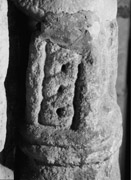
Object type: Part of a round-shaft with upper section [1]
Measurements: H. 80 cm (31.5 in); W. 35 > 25 cm (13.8 > 9.8 in); D. 24 > 15 cm (9.5 > 5.9 in)
Stone type: Poorly sorted, pink to light-brown (5YR 6/4) to greyish orange pink (5YR 7/3) feldspathic sandstone. In parts particularly feldspar-rich and coarse-grained, with clasts up to 5 mm across. Kinderscout Grit or Ashover Grit, Millstone Grit Group, Carboniferous (R.T.)
Plate numbers in printed volume: Ills. 57–60
Corpus volume reference: Vol 13 p. 129-130
(There may be more views or larger images available for this item. Click on the thumbnail image to view.)
A (broad): This face is decorated on its upper portion by what appears to be a wide moulding inside the edge mouldings and the collar below. It appears as a U-shape, although the top is broken away. Below the upper decoration is a double collar. Approximately two-thirds of the monument below the collar is the round-shaft portion where the stone is undecorated, tapering as it rises.
B (narrow): This face is decorated at the top by a non-symmetrical, two-strand interlace where the upper strands descend as curving lines, lying adjacent to each other and resembling vertical waves. The upper part of the pattern is missing. At the bottom, the two strands cross over each other and form a return loop. On each side are edge mouldings which hint at being of the cable type, although they are quite worn. Below the double collar is the plain round section of the shaft.
C (broad): Obscured by its location in the display in the church porch. However, it does seem to be decorated by a plait or interlace design.
D (narrow): The upper section is decorated by a simple, two-strand interlace although the top is missing where the stone has been broken away. The interlace terminates at the bottom with a returned loop. There is a hint that the strands may have been doubled, although wear makes this uncertain. On either side are edge mouldings that appear to be of the cable type, although quite worn. Below is the double collar and, below this, the plain round section of the shaft.
This is a round-shaft cross (type g/h: Cramp 1991, fig. 1), comprising most of the rounded stem and part of the upper rectangular section. Round-shafted crosses are found in several parts of England but a considerable number of a type similar to Bakewell 25 are found throughout this region (at Alstonefield, Brailsford, Chebsey, Darley Dale, Ilam, Leek, Stoke-on-Trent and Two Dales), and to the west, at fourteen sites in Cheshire (Bailey 2010, 33-7); most are concentrated around the border area between northern Derbyshire, north-eastern Staffordshire and south-eastern Cheshire (Sidebottom 1994, 114, 119-20, distribution map 9).
Collingwood (1927, 5–9) suggested that the round-shafted crosses were modelled on earlier wooden versions–‘staff roods’–and seemed to regard them as a separate class of monument. Pape (1945–6) also considered that round-shafted crosses should be considered separate from the more familiar rectangular cross-shafts and, indeed, chose to record them as such in his 1945 paper (see Chapter I). Many of the round-shafted crosses, however, share motifs with their rectangular-shaft counterparts (Sidebottom 1994, 114-23). The shape of the monument may thus not have been significant in the Anglo-Saxon period and the choice between a round shaft and a rectangular shaft may have simply been pragmatic. It is feasible that many of smaller round-shafted crosses in this region may have been fashioned from reused Roman milestones or similar columns. This would account for the tapered design where the lower part of the shaft (as in this case) is plain, representing the surface of the original milestone, with the upper part carved away to create the tapered appearance.
The motifs carved on the upper portion of this shaft are similar to others in the region: Chebsey (1), Staffordshire, for instance, has an irregular line pattern on A; and the two-strand interlace is found on Two Dales 1, Ilam 2, Leek 6 and Alstonefield 8. This strongly suggests a regional grouping, irrespective of the shape of the monument (see Chapter III).
