Select a site alphabetically from the choices shown in the box below. Alternatively, browse sculptural examples using the Forward/Back buttons.
Chapters for this volume, along with copies of original in-text images, are available here.


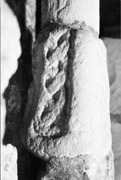
Object type: Probably the upper part of a round-shaft [1]
Measurements: H. 32 cm (13 in); W. 27 > 21 cm (10.5 > 8.5 in); D. 20 > 19 cm (8 > 7.5 in)
Stone type: Fine-grained, moderate orange pink (5YR 7/4) feldspathic sandstone. Millstone Grit Group, Carboniferous (R.T.)
Plate numbers in printed volume: Ills. 54–6
Corpus volume reference: Vol 13 p. 128-129
(There may be more views or larger images available for this item. Click on the thumbnail image to view.)
A (broad): Decorated with an incomplete four-strand, simple interlace where two of the strands terminate in a closed loop at the bottom. The other two strands, which extend lower than the others, connect with the edge moulding to the right and may have connected to the left-hand moulding although this detail, along with the upper part of the decoration is missing. On each side are worn edge mouldings which may have been rolled. Below is a wide horizontal moulding.
B (narrow): This face is decorated with a three-strand, simple interlace which appears to have been median-incised, although the upper part of the pattern is badly worn. It terminates at the bottom with two strands making a returned loop, the other disappearing underneath the loop. The pattern is contained within an outer edge moulding which curves below the pattern to form a U-shape. The bottom of the outer moulding appears to have been of the cable type although the detail on the vertical sides is worn away.
C (broad): Inaccessible, due to its display against the porch wall, but it appears to be decorated with another simple interlace.
D (narrow): This face is also decorated with a three-strand, simple interlace which appears to have been median-incised, although somewhat worn. It terminates at the bottom with two strands making a returned loop; the other appears to be connected to the loop at the bottom. The pattern is contained within an outer edge moulding which curves below the pattern to form a flattened U-shape. The moulding is quite worn and detail has been lost.
This stone appears to be the upper, rectangular-sectioned, portion of a round-shafted cross, which are generally understood to mark Scandinavian-period activities. It is similar to examples elsewhere in the region (at Ilam 2 and Alstonefield in Staffordshire) and in eastern Cheshire at Adlington or Sutton (Bailey 2010, 45-6, 126-8). The interlace patterns on the three visible faces appear irregular which might suggest that the sculptor was not highly skilled. Many of the round-shafted crosses in the region are highly decorated on their upper portions, whereas the lower, cylindrical portion is often undecorated, being separated from the rectangular top section by a single or double collar moulding. Many are also ovoid in section and this is transferred to the upper portion to produce a rectangular cross-section, as in this case. The decoration, using simple three- and four-strand interlaces, is again typical of round-shaft crosses.
