Select a site alphabetically from the choices shown in the box below. Alternatively, browse sculptural examples using the Forward/Back buttons.
Chapters for this volume, along with copies of original in-text images, are available here.


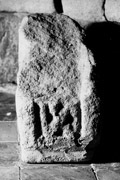
Object type: Part of shaft [1]
Measurements: H. 30 cm (11.75 in); W. 32 cm (12.5 in); D. 16 cm (6.25 in)
Stone type: Fine-grained, pale brown (5YR 6/3) feldspathic sandstone. Millstone Grit Group, Carboniferous (R.T.)
Plate numbers in printed volume: Ills. 68–71
Corpus volume reference: Vol 13 p. 134
(There may be more views or larger images available for this item. Click on the thumbnail image to view.)
All four faces are bounded by wide vertical angle mouldings which on A are inset with thin narrow mouldings.
A (broad): Decoration consists of the lower portion of a figure wearing a full-length robe. The mortar across the lower edge obscures the feet making it impossible to tell if the figure was forwards-facing or standing in profile. One arm crosses the body to hold a square object over the left-hand side. The area between the legs has not been cut away, leaving what appears to be a small pellet.
B (narrow): The lower termination of a run of interlace of indeterminate type survives below the break in the stone.
C (broad): The remains of two seemingly separate runs of interlace are contained within the wide angle-mouldings: to the right the pattern is no longer clear; to the left it appears to comprise a three-strand plait.
D (narrow): A run of three-strand interlace is contained by the angle moulding; the lower portion of this is obscured by the mortar still adhering to the surface.
See Bakewell 10 (p. 117) for discussion of the figure type. The interlace designs found on this piece are also found widely across the region.
