Select a site alphabetically from the choices shown in the box below. Alternatively, browse sculptural examples using the Forward/Back buttons.
Chapters for this volume, along with copies of original in-text images, are available here.


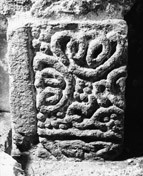
Object type: Part of shaft [1]
Measurements: H. 35.5 cm (14 in); W. 28 cm (11 in); D. 23 cm (9 in)
Stone type: Very pale orange (10YR 8/4) weathering to a very dark grey, poorly sorted, bioclastic limestone with a few recognizable shell fragments. Sub-rounded shell fragments ranging from 0.3 to 5 mm occur. What appear to be ooliths are probably well rounded shell fragments. Possibly from the Eyam or Monsal Dale Limestone Formation?, Peak Limestone Group, Carboniferous Limestone Supergroup (C.R.B.)
Plate numbers in printed volume: Ill. 49
Corpus volume reference: Vol 13 p. 127
(There may be more views or larger images available for this item. Click on the thumbnail image to view.)
A (broad): Decorated on the top and left-hand side with two closed-circuit asymmetrical looped patterns. They appear to be attached to the rest of the decoration firstly by a strand from the inner loops of the upper pattern extending to the right (the rest of the pattern being broken away), and secondly with a further strand connecting the two closed-circuit patterns together. To the left of the uppermost looped pattern is a cluster of four berries, with a further cluster of six berries in the centre. Below is an asymmetrical arrangement of interlace strands from which two further series of berries extend to the left and right. This extends to the right where the stone has been broken off. Below is a thin horizontal moulding which separates the decoration from what appears to be a two-strand plait, although this is too fragmentary to be certain. To the left is a badly weathered edge moulding (or possibly a panel divider).
B and D (narrow): Dressed-off
C (broad): Inaccessible
This piece is one of several in the region decorated with asymmetrical design elements, and employs the use of berry clusters along with other pieces at Bakewell. It is too fragmentary to understand the complete register of patterning but it may have been the upper part of a panel which has been placed on its side. Such patterns suggest that they were influenced by the more well-crafted monuments, such as Bakewell 1, although less well accomplished and considered to be later monuments.
