Select a site alphabetically from the choices shown in the box below. Alternatively, browse sculptural examples using the Forward/Back buttons.
Chapters for this volume, along with copies of original in-text images, are available here.


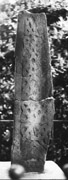
Object type: Part of shaft
Measurements:
H. 120 cm (47.24 in); W. broken at base, 22 cm (8.6 in) at top
D. 20 > 13 cm (7.9 > 5.1 in)
Stone type: Moderately well-sorted, pale brown (5YR 6/3), feldspathic sandstone, with grains up to 0.7 mm. Namurian sandstone consistent with Chatsworth Grit (of Staffordshire facies) and Kniveton Sandstone, Millstone Grit Group, Carboniferous. Note: this lithology contrasts with the Westphalian sandstone of the present church and the Triassic sandstone of the earlier ruins (R.T.)
Plate numbers in printed volume: Ills. 603–6
Corpus volume reference: Vol 13 p. 308
(There may be more views or larger images available for this item. Click on the thumbnail image to view.)
A (broad): Decorated with a complete interlace pattern of two strands comprising a series of mirrored loops arranged as Stafford Knots (simple pattern E: Cramp 1991, fig. 23). The bottom of the panel is damaged but the pattern appears to be complete. It terminates in an inverted-V strand. On each side is a flat-band edge moulding.
B (narrow): This face is decorated with a simple three-strand interlace which tapers towards the top and is somewhat irregular. The bottom of the interlace is damaged where the stone has been dressed-off. Flat-band edge mouldings are visible on each side.
C (broad): Decorated with a panel containing a squared plant-scroll pattern, terminating in a cluster of three leaves in the centre of each volute. The bottom of the plant-scroll is damaged where the stone has been dressed-off and the right edge moulding has been removed when the stone was reformed as a building component at a later date.
D (narrow): Decoration survives on the upper fifth of the shaft only. It comprises a line or key pattern (meander 2: Cramp 1991, fig. 27) with flat-band mouldings on each side. The lower part of the face has been cut away when it was reused as a building component.
Although this is a rectangular-sectioned shaft, its decorative repertoire is more usually found on round-shaft crosses in this region. For example, similar patterns, especially the squared plant-scroll on C and the line pattern on D, can be seen on Leek 6 (Ills. 582, 585), along with simple interlace patterns, and at Brailsford, Derbyshire (Ills. 129-30). The line or key pattern is found elsewhere, at Alstonefield (e.g. 7) and at Ilam (2), Darley Dale (2), Bakewell (27B). Further afield, the same pattern can be seen at several locations in Cheshire (e.g. Cheadle 1; Bailey 2010, 60–2). All these comparanda occur on round-shafts; the one exception is the large rectangular-sectioned shaft at Leek (2), which has a similar stylised plant-scroll (2B), and also the possible remains of a line pattern on 2D (Ills. 568, 566).
