Select a site alphabetically from the choices shown in the box below. Alternatively, browse sculptural examples using the Forward/Back buttons.
Chapters for this volume, along with copies of original in-text images, are available here.


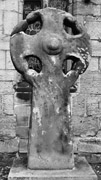
Object type: Cross-head and shaft
Measurements:
H. 176 cm (69.3 in); W. 51 > 40 cm (20 > 15.75 in); D. 36 > 24 cm (14.2 > 9.45 in)
Diam. of cross-head 93 cm (36.6 in)
Stone type: Light grey (N7), well sorted, medium-grained, clast-supported, quartz sandstone. Grain size varies from 0.3 to 0.8 mm, but is mainly in the range 0.4 to 0.5 mm, with a few well-rounded quartzose pebbles. The sub-angular to sub-rounded, equidimensional, clasts are mostly clear quartz, but there are scattered, angular and sub-rounded, feldspars up to 2 mm across, together with pink barytes. 'White sandstone' form of the Helsby Sandstone Formation, Sherwood Sandstone Group, Triassic (R.T. & C.R.B.)
Plate numbers in printed volume: Ills. 607–10
Corpus volume reference: Vol 13 p. 309
(There may be more views or larger images available for this item. Click on the thumbnail image to view.)
A (broad): The decoration on this face is worn away on the lower shaft but the cross-head retains vestiges of decoration on the right-hand side where a small portion of interlace can be seen. There is a central boss with surrounding raised ring.
B (narrow): This face is decorated on the shaft by a panel containing what may be a half-pattern interlace although it is now badly weathered and difficult to discern. The panel is contained between two mouldings, outside of which are edge mouldings; that on the left appears to be cable moulded. Any decoration on the cross-head has now worn away except for chevron markings on the lower part of the head. There appears to be a badly-worn thin edge moulding around the cross-head.
C (broad): The decoration on this face has now weathered away so that no detail survives on either the shaft or cross-head. The central boss has been broken or carved way (possibly when it was set into the church floor).
D (narrow): This face is decorated on the shaft with a panel containing what may be a half-pattern interlace, although it is now badly weathered and difficult to discern. The panel is contained on the right-hand side by a moulding, outside of which is an edge moulding. Any decoration on the cross-head has now worn away.
This is an unusual piece, partly because it has a complete cross-head (type 8/9), but mainly because the monument, with its large cross-head, was carved from a single piece of stone. Large in proportion to the shaft, the cross-head is of the ring-headed type with rounded arm-pits, where the ends of the arms appear to touch each other and are joined. It follows the same lateral taper as the shaft below. This type of cross-head is similar to that found at Leek (5) where, again, the ends of the arms touch each other and are joined (Ills. 579-81). The decoration has now all but worn or weathered away, making parallels with other pieces almost impossible.
