Select a site alphabetically from the choices shown in the box below. Alternatively, browse sculptural examples using the Forward/Back buttons.
Chapters for this volume, along with copies of original in-text images, are available here.


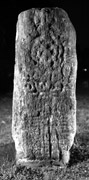
Object type: Part of shaft
Measurements: H. 127 cm (50 in); W. 50 > 43 cm (19.7 > 16.9 in); D. 46 > 35 cm (18.1 > 13.8 in)
Stone type: Very pale orange (10YR 8/2), poorly sorted, clast-supported, bioclastic, oolitic, limestone. Sparse ooliths range from 0.3 to 0.7 mm across. Some ooliths are matrix supported and stand proud, whilst others have fallen out to give an 'aero-chocolate' texture. Bioclasts are up to 2 mm, with a few elongate bivalve– fragments up to 10 mm across; one turreted gastropod noted. Finely bedded at right-angles to front face. Barnack Rag–, Upper Lincolnshire Limestone Formation, Jurassic (C.R.B.)
Plate numbers in printed volume: Ills. 410–15
Corpus volume reference: Vol 13 p. 229-230
(There may be more views or larger images available for this item. Click on the thumbnail image to view.)
The damage sustained by this incomplete cross-shaft means the carved decoration is really only visible on A with a little discernible on D.
A (broad): What appears to be a Latin cross with a decorated median moulding set in the arms fills the lower part of the shaft. Above are vestiges of a thin band of interlace that includes a series of spirals with strands perhaps rising on the right-hand side. Above this, a circular motif is visible which appears to be part of a further interlace pattern worn away at the top; it is contained by a U-shaped moulding.
B (narrow): Badly worn; no decoration survives.
C (broad): Also badly worn and the identification of any surviving decoration is further frustrated by additional damage caused by fissures in the stone, several holes and many chips in the surface.
D (narrow): Most of the decoration has been worn away, but a cruciform design similar to that on A can still be discerned on the lower part of the shaft. The decoration on the upper part of the shaft is now missing and there is damage at the base.
Made from limestone, the remains of this shaft appear to have been particularly susceptible to erosion from acidic rain. Indeed, Routh (1937a, 35; 1937b, 38) remarked on how much the stone had degraded since Browne made a rubbing of it (Browne 1886, 178, pl. XIV.6; see Ill. 410). Its material is also unusual for the region, as even those monuments erected in the Derbyshire Limestone Peak District are made from sandstone.
Although the decoration on the shaft is so badly eroded, Browne’s rubbing published in 1886 provides some evidence of what has been lost from A. His focus on this face may suggest that even in the later nineteenth century he considered the decoration of the other three faces too badly damaged to be worth recording. The rubbing shows that the vertical arm of the cross in the lower part of the shaft extended down towards the base, and so was longer than the other three, confirming it as a Latin, rather than Greek cross. It further reveals that the median strip filling the (vertical) cross-arms was a decorated cable moulding, and that the cross was separated from the decoration above by a horizontal moulding or bar. The spiral form of the band of interlace above (pattern A: Cramp 1991, xxx) is also confirmed by Browne’s drawing of the rubbing, which further shows that strands extended at both outer ends into the pattern above: that on right passed over the U-shaped moulding containing the upper pattern; the other passed beneath it. This uppermost pattern is further revealed to have been an irregular interlace comprising a spiral loop formed from one strand with a V-bend return loop which extended from the broken top of the shaft. It was otherwise formed from the two strands extending from the spiral interlace below; these interlaced through the pattern and extended up towards the break in the stone.
As revealed by Browne’s rubbing, this decorative repertoire is not unusual for the area; the rather irregular interlace on the upper part of A is echoed by similar designs with V-loop returns at Derby (e.g. 1 and 11), Repton (15), Blackwell East (1), as well as Tatenhill (1) in Staffordshire and elsewhere in the north Midlands (at Asfordby, Leicestershire, for example). In many of these cases some form of zoomorph is included, but if this were the case at Spondon, then this part of the decoration is now lost. The U-shaped moulding is also similar to those found on the upper portions of the round-shafts found in the north-west of the region, although this was clearly not a round-shaft. The cross filling the lower parts of A and D is unusual however, both in this region and elsewhere in the corpus of Anglo-Saxon art, with the use of cable moulding to decorate the arms of what is otherwise an outline Latin cross, though Glentworth 1 in Lincolnshire (Everson and Stocker 1999, ill. 179) has something similar. While clearly not depicting the Crucifixion, the motif of the cross indicates a Christian frame of reference, if not an ecclesiastical role in the production of the monument.
