Select a site alphabetically from the choices shown in the box below. Alternatively, browse sculptural examples using the Forward/Back buttons.
Chapters for this volume, along with copies of original in-text images, are available here.


Object type: Fragment
Measurements: H. 30 cm (11.8 in); W. 56 cm (22 in); D. unknown
Stone type: The panel is set just a little too high, even with a short step ladder, to carry out a close inspection. Very pale orange (10YR 8/2), moderately sorted, clast-supported, quartz sandstone. The sub-angular to sub-rounded grains vary from 0.4 to 0.9 mm, but are dominantly between 0.5 and 0.7 mm. Millstone Grit Group, Carboniferous (C.R.B.).
Plate numbers in printed volume: Ill. 476
Corpus volume reference: Vol 13 p. 258-259
(There may be more views or larger images available for this item. Click on the thumbnail image to view.)
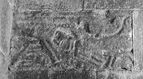
A (broad): Although difficult to discern, the visible face appears to show several animal depictions. On the left-hand side, is about two-thirds of a horse showing the head, front legs and body (the rear legs are missing where the stone has been broken away) facing to the right. Below is another design—possibly of another animal—but this is unclear. In front of the horse’s legs and below its head and neck is a further small creature, possibly another horse. To the right and above the horse is what appears to be a biped, probably a bird with a broad body and down-curving beak, facing to the left. To its right is another design element which cannot be discerned. Below this are the remains of the body of animal with legs bent under, as if falling, truncated on the right-hand side, but again this is unclear. Underneath the body of this latter creature, and to the right of its legs is possibly the body and front legs of another animal; this, however, is too badly worn to interpret with any certainty.
At the top of the panel is a horizontal cable moulding extending almost the full width of the panel, below which is another cable moulding which extends only half the width of the panel from the left. At the bottom of the panel are the remains of what appear to be another moulding on the left-hand side but this is badly worn and incomplete.
Appendix B item (stones wrongly associated with pre-Conquest period)
The coherent, naturalistic animals featured on this piece are dissimilar to other zoomorphs recorded in this volume which tend to take the form of fantastical creatures rather than natural forms, as for example, at Derby (e.g. 1 and 2). In almost all cases, Anglo-Saxon zoomorphs are attached to interlace or tendrils, whereas those on this stone are free from any immediate background or interlinking decoration. They thus resemble creatures featured in later medieval animal art found in several locations in the region: at Darley Dale, for instance, where a similar horse is found on a small panel (Ryder 2016, 64, fig. 10), and at Wirksworth. Such depictions are normally regarded to be from the Norman period. Cox (1877b, 274) also considered the panel to be Norman and probably part of a reused tympanum; he mentions ‘foliage’ on the panel, but this is no longer discernible.
