Select a site alphabetically from the choices shown in the box below. Alternatively, browse sculptural examples using the Forward/Back buttons.
Chapters for this volume, along with copies of original in-text images, are available here.


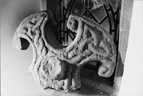
Object type: Cross-head (incomplete)
Measurements: H. 72 cm (28.35in); W. 70 cm (27.5 in); D. 17 cm (6.7 in, excluding central boss)
Stone type: Greyish orange pink (5YR 7/2), poorly sorted, clast-supported, medium-grained. The clasts, mainly quartz with a few feldspar grains vary from sub-angular to sub-rounded, between 0.3 to 0.7 mm across, with a few up to 1.0 mm across, but most are medium-grained between 0.4 and 0.5 mm. Millstone Grit Group, Carboniferous (C.R.B.)
Plate numbers in printed volume: Ills. 408–9
Corpus volume reference: Vol 13 p. 228-229
(There may be more views or larger images available for this item. Click on the thumbnail image to view.)
The decoration is limited to both broad faces, and is contained by a single plain edge roll moulding which terminates in scrolled curls at the ends of each arm.
A (broad): Decorated with a protruding central circular boss surrounded by strands of interlace extending from the arms. One edge of the boss is broken off. The two surviving arms are decorated in similar fashion with a two-strand simple interlace twist that terminates at the outer edges in a pair of V-shaped loops resembling a ‘triquetra’.
B and D (narrow): Plain but dressed
C (broad): This face, like A, is decorated with a protruding central circular boss, surrounded by strands of interlace extending from the arms. The two surviving arms are also decorated in similar fashion with a two-strand simple interlace twist which terminates at the end of the arms in a pair of V-shaped loops, resembling a ‘triquetra’. There is, however, a slight difference: an extra or misplaced strand has been introduced close to the terminal of the arm on the left.
When complete, this was a large cross-head of type E9 (Cramp 1991, xvi, fig. 2), some 73 cm (28.7 in) in diameter, with wedge-shaped arms featuring scrolled terminals and wide rounded armpits. Unique in the extant corpus of this region with its scrolled arm terminals, the decorative repertoire, featuring a central boss and two-stranded interlace, is nevertheless typical of several cross-heads in the immediate region. Examples can be found at Pym Chair (1), One Ash (1 and 2), along with the cross-head now missing from Elton Moor (1), and in Staffordshire, at Leek (5); see Ills. 192-5, 237-42, 243-5, 579-81. Scrolled arm terminals are also found elsewhere, on Repton 10, and Tatenhill 1 in Staffordshire (Ills. 319-21, 607), and further afield, on Amesbury 1, Wiltshire (Cramp 2006a, ills. 383-7), and Hanley Castle 1 in Worcestershire (Bryant 2012, ill. 640).
