Select a site alphabetically from the choices shown in the box below. Alternatively, browse sculptural examples using the Forward/Back buttons.
Chapters for this volume, along with copies of original in-text images, are available here.


Object type: Four pilaster fragments
Measurements:
i. RF 5684: three-sided pilaster strip. L. 12 cm (4.7 in); W. 9.6 cm (3.8 in); H. (of projection) 4.5 cm (1.8 in)
ii. RF 5686: three-sided pilaster strip. L. 13.8 cm (5.4 in); W. 8.7 cm (3.4 in); H. (of projection) 4 cm (1.6 in)
iii. RF 4498: three-sided pilaster strip. L. 17.5 cm (6.9 in); W. 8.5 cm (3.3 in); H. (of projection) 5.5 cm (2.2 in)
iv. RF 1837: adzed-dressed stone worked roughly to a curve. L. 31 cm (12.2 in); W. 11 cm (4.3 in); H. 25 cm (9.8 in)
Stone type: Greyish orange pink (5YR 7/2), moderately to well sorted, clast-supported, quartz sandstone. The sub-angular to sub-rounded clasts vary from 0.3 to 0.5 mm, but are dominantly 0.4 mm across. The clasts are dominantly quartz, but a few pinkish feldspars and a few flakes of white mica are present. Helsby Sandstone Formation, Sherwood Sandstone Group, Triassic (C.R.B.)
Plate numbers in printed volume: Fig. 45a–f
Corpus volume reference: Vol 13 p. 227-228
(There may be more views or larger images available for this item. Click on the thumbnail image to view.)
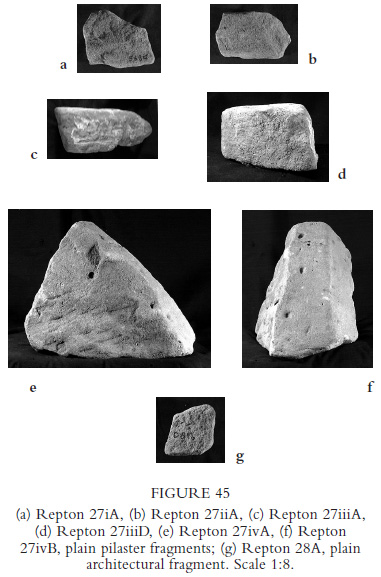
Pieces i–iii retain elements of raised pilaster strips of rectangular section; iv preserves one, possibly more layers, of ‘whitewash’
The discovery of these broken fragments in features datable to 873–4 shows that pilaster strips were features of the Anglo-Saxon stone buildings at Repton prior to that date.
