Select a site alphabetically from the choices shown in the box below. Alternatively, browse sculptural examples using the Forward/Back buttons.
Chapters for this volume, along with copies of original in-text images, are available here.


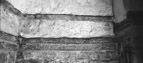
Object type: Crypt Interior
Measurements: See Description
Stone type: (of sculptural elements throughout crypt) Yellowish grey (7/2), dominantly moderately sorted, clast-supported, quartz sandstone. Overall, the sub-angular to sub-rounded grains range from 0.1 to 0.5 mm across, but for any one stone, the grain-size range is usually not more than 0.2 mm and most stones are medium-grained in the range 0.3 to 0.4 mm. Helsby Sandstone Formation, Sherwood Sandstone Group, Triassic (C.R.B.)
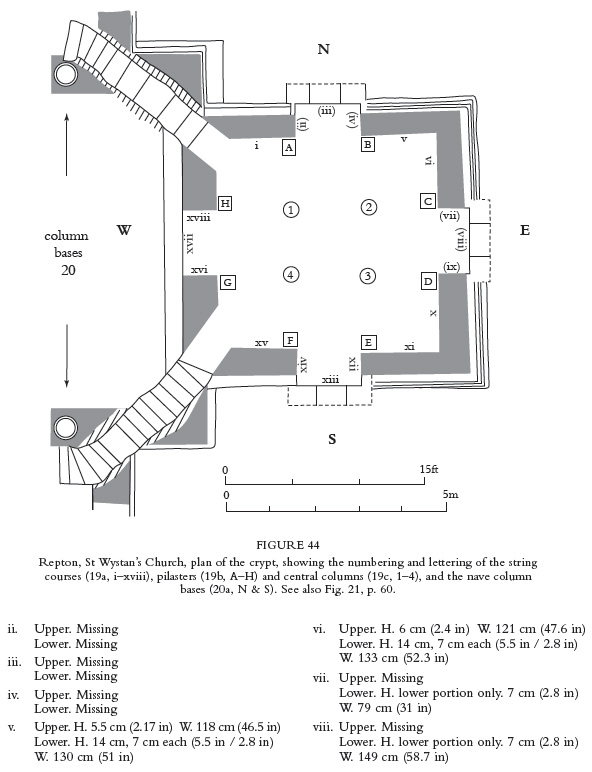
Plate numbers in printed volume: Ill. 349; Figs. 21, 27a–b, 44
Corpus volume reference: Vol 13 p. 219-223
(There may be more views or larger images available for this item. Click on the thumbnail image to view.)
19a. String courses (Ills. 350–1)
- Upper. H. 7 cm (2.75 in); W. 136 cm (53.5 in)
Lower. H. 16 cm, 8 cm each (6.3 in / 3.15 in); W. 120 cm (47.2 in)
- Upper. Missing
Lower. Missing
- Upper. Missing
Lower. Missing
- Upper. Missing
Lower. Missing
- Upper. H. 5.5 cm (2.17 in); W. 118 cm (46.5 in)
Lower. H. 14 cm, 7 cm each (5.5 in / 2.8 in); W. 130 cm (51 in)
- Upper. H. 6 cm (2.4 in); W. 121 cm (47.6 in)
Lower. H. 14 cm, 7 cm each (5.5 in / 2.8 in); W. 133 cm (52.3 in)
- Upper. Missing
Lower. H. lower portion only. 7 cm (2.8 in); W. 79 cm (31 in)
- Upper. Missing
Lower. H. lower portion only. 7 cm (2.8 in); W. 149 cm (58.7 in)
- Upper. Missing
Lower. Missing
- Upper. H. 5.5 cm (2.17 in); W. 121 cm (47.6 in)
Lower. H. 14.5 cm (5.7 in): top H. 7.5 cm (3 in); bottom H. 7 cm (2.8 in); W. 136cm (53.5 in)
- Upper. H. 5.5 cm (2.17 in); W. 125 cm (49.2 in)
Lower. H. 14.5 cm (5.7 in): top H. 7.5 cm (3 in); bottom H. 7 cm (2.8 in); W. 139 cm (54.7 in)
- Upper. Missing
Lower. H. lower portion only. 7 cm (2.8 in); W. 80 cm (31.5 in)
- Upper. Missing
Lower. H. lower portion only. 7 cm (2.8 in); W. 140 cm (55 in)
- Upper. Missing
Lower. Missing
- Upper. H. 7 cm (2.8 in); W. 103 cm (40.5 in)
Lower. H. 15.5 cm (6.1 in): top H. 7.5 cm (3 in); bottom H. 8 cm (3.15 in); W. 112 cm (44.1 in)
- Upper. Missing
Lower. H. 17 cm (6.7 in): top H. 9 cm (3.5 in); bottom H. 8 cm (3.15 in); W. 76 cm (30 in)
- Upper. Missing
Lower. H. 16cm, 8 cm each (6.3 in / 3.15 in) W. 145 cm (57.1 in)
- Upper. Missing
Lower. H. 16 cm, 8 cm each (6.3 in / 3.15 in); W. 70 cm (27.6 in)
Two distinct string-courses, separated by a plain area of wall (about 25 cm [9.8 in] wide) form a double cornice that runs along the top of the north, south and east walls. The upper string-course is composed of a single layer of stones rectangular in section; the lower has a double-stepped profile composed of two stones, the upper projecting beyond the lower, and each slightly chamfered. Only the double-stepped string-course appears on the west wall, where it runs around all three walls of the recess, but not along the top of the walls flanking the recess.
19b. Pilasters (Ills. 356–8, 359–66)
- Overall H. 199cm (78.3 in)
Pilaster H. 178 cm (70.1 in); W. 29 cm (11.4 in); D. 39 cm (15.4 in)
Capital H. 14 cm (5.5 in); W. 43 cm (16.9 in); D. 43 cm (16.9 in)
- Overall H. 199 cm (78.3 in)
Pilaster H. 167 cm (65.7 in); W. 30 cm (11.8 in); D. 38 cm (14.9 in)
Capital H. 18 cm (7.1 in); W. 48 cm (18.9 in); D. 43 cm (16.9 in)
- Overall H. 195 cm (76.8 in)
Pilaster H. 172 cm (50 in); W. 26 cm (10.2 in); D. 37 cm (14.6 in)
Capital H. 11.5 cm (4.5 in); W. 34 cm (13.4 in); D. 45 cm (17.7 in)
- Overall H. 197 cm (77.6 in)
Pilaster H. 175 cm (68.9 in); W. 36 cm (14.2 in); D. 39 cm (15.4 in)
Capital H. 15 cm (5.9 in); W. 42 cm (16.5 in); D. 41.5 cm (16.3 in)
- Overall H. 201 cm (79.1 in)
Pilaster H. 183 cm (72 in); W. 32 cm (12.6 in); D. 38 cm (14.9 in)
Capital H. 15 cm (5.9 in); W. 49 cm (19.3 in); D. 44 cm (17.3 in)
- Overall H. 196 cm (77.1 in)
Pilaster H. 179 cm (70.5 in); W. 33 cm (12.9 in); D. 37 cm (14.6 in)
Capital H. 12 cm (4.7 in); W. 47 cm (18.5 in); D. 45 cm (17.7 in)
- Overall H. 197 cm (77.6 in)
Pilaster H. 172 cm (50 in); W. 30 cm (11.8 in); D. 42 cm (16.5 in)
Capital H. 13.5 cm (5.3 in); W. 46 cm (18.1 in); D. 44 cm (17.3 in)
- Overall H. 208 cm (81.9 in)
Pilaster H. 179 cm (70.5 in); W. 28 cm (11 in); D. 36 cm (14.2 in)
Capital H. 16 cm (6.3 in); W. 42 cm (16.5 in); D. 47 cm (18.5 in)
Eight pilasters stand against (but are not bonded with) the walls of the crypt, framing the recesses in the east, west, south and north walls. They are composite structures, each composed of three pieces of stone, and support capitals of comparable design to those set on the columns of the crypt (19c) and of Repton 20b, but without such clearly-defined basal roll-mouldings, and retain traces of gesso and red paint. Each of the three visible faces displays a recessed, round-headed panel, the field of which is V-shaped in plan such that an arris runs vertically up the centre of each panel (see Ills. 356–66). This is bounded by a plain raised border running down to the floor but without any defined base. The pilasters and capitals are straight-jointed against the double string-course (19a).
19c. Columns with capitals and bases (Figs. 19, 21, 27a–b, 44; Ills. 349, 352–5)
- Overall. H. 200 cm (78.7 in)
Column. H. 168 cm (66.1 in); Circumference 122 > 104 cm (48 > 40.9 in)
Capital. H. 22 cm (8.7 in); W. 49 cm (19.3 in); D. max. 46 cm (18.1 in)
- Overall. H. 201.5 cm (79.3 in)
Column. H. 165 cm (64.9 in); Circumference 120 > 109 cm (47.2 > 42.9 in)
Capital. H. 28 cm (11 in); W. 48 cm (18.9 in); D. max. 46 cm (18.1 in)
- Overall. H. 197 cm (77.6 in)
Column. H. 167 cm (65.7 in); Circumference 125 > 110 cm (49.2 > 43.3 in)
Capital. H. 29 cm (11.4 in); W. 52 cm (20.5 in); D. max. 46.5 cm (18.3 in)
- Overall. H. 206 cm (81.1 in)
Column. H. 153.5 cm (60.4 in); Circumference 134 > 109 cm (52.8 > 42.9 in)
Capital. H. 29 cm (11.4 in); W. 50 cm (19.7 in); D. max. 46 cm (18.1 in)
Four monolithic columns rest on annular bases, with capitals supporting the vaulting of the crypt, which are square in section and replicate the design of those associated with Repton 20, including the basal roll moulding which is not so obviously present on the capitals of the pilasters in the crypt (19b). The body of each column is carved with a narrow roll moulding that spirals round its length. Large amounts of gesso and red paint adhere to the columns and the capitals (Fig. 27a–b, pp. 66–7).
The rectangular masonry structure which forms the first stage of the Repton crypt was sunk to a depth of about 180 cm (71 in) below the surface from which it was built. Externally, the above-ground walls are faced on the north, west, and south sides with large blocks of brown ‘Bunter sandstone’ which are either set back, one above another, to form ledges, or are themselves dressed back on their exposed faces to form two steps, together providing a series of sometimes three but along the eastern face of the crypt as many as four stepped plinths (Taylor 1987, pl. XXVI).
Internally, walls of regularly coursed large blocks of carefully dressed ‘Keuper Greensand’ rise from the floor to a height of about 160 cm (63 in) to the underside of a double string-course (19a), also of ‘Keuper Greensand’, which runs round three sides of the crypt, but not the west, and around all three sides of each of the deep rectangular niches on its four faces (the north niche is almost wholly destroyed from below the level of these string-courses, but remnants of both courses survive on the west side of the niche (Taylor 1987, pl. XXVII b). The string-course is composed throughout, for a total original length of approximately 2040 cm (804 in), of two superimposed courses of Bunter sandstone to form a double string-course topping the vertical walls below. Each of the four niches was originally covered by a stone vault, but this only survives intact over the west niche.
Contrary to previous suggestions (Taylor 1987, 211–13, 219–20, 243 (Phase 2), figs. 3 and 6) the first stage of the crypt was entered by diagonal passages at the north-west and south-west corners. The finely-dressed faces of the Keuper Greensand blocks at the inner openings of both passages return inwards to form the inner sides of the passages (ibid., fig. 12). The corresponding blocks forming the outer corners follow suit. This first phase was served by a stone-built drain found in excavation outside the east wall of the crypt (Feature 1116: Raxworthy et al. 1990, fig. 1; Biddle and Kjølbye-Biddle 2001, fig. 4.8, at the north end of the drawn section). This approached the crypt from the north-east, changing its line to pass at right-angles under the east wall. Inside the crypt, the sides of the drain are visible today in the stone floor, turning to run toward the centre of the crypt before being interrupted by the boulder forming the base of Column 2, the insertion of which would have made the drain inoperable.
In a second stage, the crypt was provided with a stone vault of nine compartments supported on the four central columns (19c, 1–4) with the eight corresponding pilasters (19b, A–H) set against the inner faces of the original walls. The openings of the four niches were framed on either side at this point by the pilasters which are decorated on three sides and straight-jointed (i.e. built up to) the pre-existing walls against which they stand. The pilasters and capitals are straight-jointed against the double string-course of the first stage of the crypt, but an upper, single string-course in the angles of the vault built in the second stage, is itself straight-jointed against the capitals and is therefore contemporary with (or possibly later than) the vault itself. The four carved columns stand on irregular blocks protruding to various degrees above the later floor of the crypt. Each is capped by a square reeded capital comparable to those on the pilasters, but rising with a taller flare from square bases finished below with a roll moulding. These carry the vault of nine bays which rest at their outer ends on the capitals of the pilasters framing the four niches.
The crypt as it exists today is thus of two phases: a primary sunken structure with niches on four sides; and a second phase in which the columns and pilasters were inserted to carry a stone vault. Both were built of carefully dressed Keuper Greensand and were entered by diagonal passages through the north-west and south-west corners.
The primary structure was built in an area of burials (Cemetery 1), suggesting the presence of an earlier church in the immediate area, probably to the west. A sceatta of c.715 found in a layer sealed by the construction of the crypt shows that this primary stage of the crypt was built after the earlier years of the eighth century. The stepped outer faces of the north, east, and south walls are visible today and have been fully explored below ground by excavation. The outer face of the west wall lies beneath the floor of the ‘central space’ of the present church and is inaccessible. The stone-lined drain suggests that the primary structure may have been a baptistery (Kjølbye-Biddle 1998, 767–8, fig. 6; for discussion of decorative elements, see further Chapter V, pp. 59-68).
