Select a site alphabetically from the choices shown in the box below. Alternatively, browse sculptural examples using the Forward/Back buttons.
Chapters for this volume, along with copies of original in-text images, are available here.


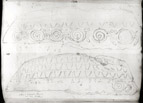
Object type: Hogback [1]
Measurements: Unavailable, but the Lysons' drawing (London: BL MS Add. 9463, fol. 54), notes an overall height of 20 in (50.8 cm), with a width, at the base, of 12 in (30.5 cm), and a length of 58.25 in (148 cm) along the moulding separating the upper and lower portions of the carved decoration.
Stone type: Unavailable, although the stone was described by Bigsby (1854, 250), as being so hard that the expense of having it cut and dressed for the dairy door-step was greater than the cost of acquiring a 'new step of the ordinary material.'
Plate numbers in printed volume: Ills. 347–8
Corpus volume reference: Vol 13 p. 218-219
(There may be more views or larger images available for this item. Click on the thumbnail image to view.)
Understanding of the general appearance of this stone depends entirely on the three sketches made by the Lysons (BL MS Add. 9463, fols. 52, 54; see Ills. 347–8), of which only the upper part was published (Lysons and Lysons 1817, ccxxiii).
A (long): The Lysons’ drawings and their published version indicates that the monument was decorated with three registers of tegulation (type 2b: Cramp 1991, fig. 7), possibly separated by incised lines, that filled the upper portion of this side. The lower portion, apparently divided from the upper by a plain moulding, seems to have contained a stylised, tightly scrolled plant motif, interspersed with off-shoots terminating in spear-shaped buds and clusters of two to three pellets.
B and D (ends) and C (long): Not recorded
Although the surviving evidence for the appearance of this hogback is preserved only as an outline sketch, it suggests that the monument, in its form and decorative repertoire, was of type h (Cramp 1991, xxi, fig. 6, scroll type). Although the thin sectional dimensions definitive of this type cannot be confirmed, the measurements given in the sketch and the diagram itself indicate a monument with a steep (tegulated) roof pitch, and a side decorated with plant-scroll ornament arranged in a horizontal strip. It may also suggest that the hogback was incomplete when uncovered: if the horizontal strip of plant-scroll were arranged symmetrically, as implied by the diagram, it would appear that the scroll on the right was originally centrally placed.
The ‘scroll type’ was regarded by Collingwood (1923b, 117; 1927, 164-5) as a (late ninth-century) Anglian prototype of the hogback form, but Lang has demonstrated the Scandinavian nature of the monument type, and its distribution in the north of England during the tenth century (Lang 1984, 101). More specifically, Repton 18 was regarded by Lang as one of the small cluster of hogbacks (of southern Derbyshire-Nottinghamshire) found outside the main distribution area of the monument form, showing traces of Yorkshire influence (Lang 1984, 88, fig. 1). See also Derby St Alkmund 8 (p. 172, Ills. 180-3).
More locally, the conditions of discovery suggest that the monument is unlikely to have been transported to Repton from elsewhere, and it thus provides evidence strongly suggesting the continuation of sculptural production at the site from the late eighth or early ninth century through the tenth century, possibly being contemporary with Phase C of the architectural activity in the church (see Chapter V, p. 56).
[1] The following is an unpublished manuscript reference to Repton 18: London, British Library, MS Add. 9463, fols. 52, 54.
[2] For the dates of Pattinson's incumbency, see Gilbert 1829; (—) 1845a, 171.
