Select a site alphabetically from the choices shown in the box below. Alternatively, browse sculptural examples using the Forward/Back buttons.
Chapters for this volume, along with copies of original in-text images, are available here.


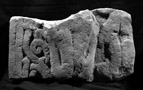
Object type: Part of grave-cover
Measurements: H. 25.5 cm (10 in); W. 48.5 > 45 cm (19.25 > 17.75 in); D. 10 cm (4 in)
Stone type: Greyish orange pink (5YR 7/2), moderately to well sorted, clast-supported, quartz sandstone. The sub-angular to sub-rounded clasts vary from 0.3 to 0.5 mm, but are dominantly 0.4 mm across. The clasts are dominantly quartz, but a few pinkish feldspars and a few flakes of white mica are present. Helsby Sandstone Formation, Sherwood Sandstone Group, Triassic (C.R.B.)
Plate numbers in printed volume: Ills. 342–46
Corpus volume reference: Vol 13 p. 218
(There may be more views or larger images available for this item. Click on the thumbnail image to view.)
(A broad): The stone is bounded on each side by a narrow flat edge moulding which contain the remains of series of wide ribbons that lie on either side of a wide element carved in very high relief–it protrudes 5 cm from the surface of the carving on either side of it–which itself is marked by a series of curved ribs flaring out from apparently rounded elements visible at the point of the upper break in the stone.
B (side): Broken, but dressed; the extent to which the central element of A protrudes is clearly visible.
F (bottom): Broken, but does not seem to have been carved.
D (side): Damaged, but dressed; again, the protrusion of the central element on A is clearly visible.
Like Repton 16 it would seem that this piece was once part of an elaborate grave-cover, with a prominent central element flanked by ornament: in this case, a fleshy plant motif on the left and the possible vestiges of a similar pattern on the right, although this might be the remains of a sinuous canine animal with its head at the top, as is found on Derby St Alkmund 2 (Ills. 152-4). It is unlikely that this stone was part of Repton 16 however, given its taper and the different depths of relief of the central element. Further distinguishing this piece is the nature of its central decoration which apparently comprises the remains of a robed figure with rounded shoulders and arms hanging down on either side, while the robe itself flares out widely below the waist; whether it was full-length cannot be ascertained given the break in the stone at this point. Nothing is held in the figure’s hands and lacking attributes it cannot be determined whether it was secular or ecclesiastical, male or female. It is, nevertheless, consistent with figural art found to the west of the region, in Cheshire, at Sandbach (Market Place 1 and 2; Bailey 2010, 99-120). Together with Repton 16 this piece provides further evidence of the varied nature of the sculptural monuments displayed at the site. The fleshy nature of the plant motif suggests the influence of southern English art produced in the later ninth and tenth centuries under the influence of the so-called Benedictine Reform.
