Select a site alphabetically from the choices shown in the box below. Alternatively, browse sculptural examples using the Forward/Back buttons.
Chapters for this volume, along with copies of original in-text images, are available here.


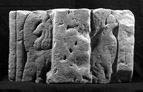
Object type: Part of grave-cover
Measurements: H. 27.5 cm (10.75 in); W. 46 cm (18 in); D. 20 cm (7.9 in)
Stone type: Greyish orange pink (5YR 7/2), moderately to well sorted, clast-supported, quartz sandstone. The sub-angular to sub-rounded clasts mostly vary from 0.3 to 0.6 mm, but there are a few scattered clasts up to 0.7 mm across; dominantly the clasts are 0.4 mm across. The clasts are dominantly quartz, but a few pinkish feldspars and a few flakes of white mica are present. Helsby Sandstone Formation, Sherwood Sandstone Group, Triassic (C.R.B.)
Plate numbers in printed volume: Ills. 336–41
Corpus volume reference: Vol 13 p. 217-218
(There may be more views or larger images available for this item. Click on the thumbnail image to view.)
A (broad): The carving is bounded on each side by a narrow flat edge moulding within which is a rounded element that, on the left, flares out towards the upper broken edge of the stone, following the curve of the neck of an animal set between it and the central element carved in high relief running the length of the centre of the stone (3 cm deep × 13 cm wide / 1.25 × 5.2 in). The inner moulding on the right is broken at the upper edge and it cannot be determined whether it mirrored that on the left. The remains of another animal are preserved between it and the central element. The animal on the left stands in profile with its head turned to rest on its back. It is characterised by a wide square snout with a small curled nostril, a gaping jaw, an eye with a dependent triangle that terminates in an incision running parallel to the upper edge of the skull; a lappet appears to emerge from the back of the head and disappear ‘under’ the central raised element. The neck is long and bends round into the body, which is carved so that the hind-quarters notionally disappear behind the central element, while the lower reaches of the fore-legs are lost in the break in the stone. The head of the animal on the right is tipped up and faces the inner moulding. Its jaw is open and holds the remains of a carved element that may represent the remains of a tongue; the eye has the characteristic dependent triangle, and a lappet extended from the back of the head. The chest protrudes out towards the inner moulding and the front leg hangs down to the break along the lower edge of the stone. It appears that the hind-quarters may have devolved into an interlaced extension, but this is unclear due to the break in the stone at this point. The wide central element flares out at the lower edge on the left, and although its surface is worn the remains of an interlaced pattern can be discerned, but whether this was plain or zoomorphic cannot be ascertained.
B and D (sides) and F (bottom): Roughly, but neatly dressed
The carving which survives on A indicates that the monument of which this piece was originally part was of extremely high quality. The animals, characterised by barrel-chests, gaping squared muzzles and prominent eyes, are found elsewhere across the region, but are particularly notable at Derby (1 and 2) and Wilne (1), with the creatures on Derby 2 lacking the double outline featured on Derby 1 and Wilne 1 and so providing a possibly closer parallel with those on Repton 16 (see Ills. 147-51, 152-4, 434-40). Unlike these sculptures however, it would seem that Repton 16 was originally a recumbent grave-cover with a prominent median strip carved in high relief, possibly running the length of the piece, with the animal ornament set on either side. The decoration did not continue onto the sides of the grave-cover, as is the case with so many of the grave-covers from Lincolnshire and Nottinghamshire (e.g. Everson and Stocker 1999, 37–41, fig. 9).
