Select a site alphabetically from the choices shown in the box below. Alternatively, browse sculptural examples using the Forward/Back buttons.
Chapters for this volume, along with copies of original in-text images, are available here.


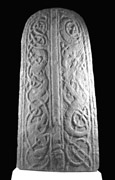
Object type: Coped grave-cover
Measurements: H. 153 cm (60.2 in); W. 55 cm (21.7 in); D. 11 cm (4.3 in)
Stone type: Greyish orange pink (5YR 7/2), poorly sorted, clast-supported quartz sandstone. The sub-angular to sub-rounded grains range from 0.3 to 1.5 mm across, with a few scattered clasts up to 4 mm. Quartz predominates, but there are a few scattered feldspars up to 8 mm across. Ashover Grit?, Marsden Formation, Millstone Grit Group, Carboniferous (C.R.B.)
Plate numbers in printed volume: Ill. 335
Corpus volume reference: Vol 13 p. 215-217
(There may be more views or larger images available for this item. Click on the thumbnail image to view.)
The stone comprises a slightly coped monument decorated on only one upper face (A).
A (broad): The carving is bounded by a continuous roll moulding and has a plain, slightly curved central moulding traversing the cope longitudinally, which tapers towards the rounded edge where it terminates in a rounded tip. The decoration, contained by plain inner roll mouldings, is arranged in two panels on either side of this median strip. Both the inner mouldings and the outer roll moulding are cut off by the squared-off horizontal edge of the stone. The decoration contained within the panels is not symmetrical. (i) That in the right-hand panel, the more worn of the two, contains two profile creatures with sub-triangular bodies with ribbon-like extensions and limbs that merge into coherent knots of interlace. One of the creatures is set two-thirds of the way along the length of the panel, its head against the inner moulding running along the central divide. It has wide open jaws that are extended towards the second creature, which is situated within the rounded end of the panel. A complete knot of interlace is visible between the horizontal edge of the stone and the first of the creatures, with strands of interlace extending from the knot into the horizontal edge. (ii) In the panel on the left, the remains of two further profile creatures can be discerned, but these are disposed such that one is set close to the horizontal edge of the stone, its back against the central divide, its hind leg touching the inner moulding on the left-hand side of the panel, and its foreleg extended out before it into the strands of interlace surrounding it. The upper curve of a knot of interlace, set between the hindquarters of this creature and the horizontal edge of the stone, is interrupted by that edge. The second creature is positioned about a third of the way along the length of the panel, with two knots of interlace filling the space between it and the rounded end of the panel.
B and D (long): Plain
F (bottom): Inaccessible
The form of this grave-cover is extremely unusual. Another example, dated to the early-ninth century, from Ramsbury, Wiltshire (Cramp 2006a, 230–1, no. 4), has been invoked in discussions of Repton 15, being coped, with its decoration arranged around a central median strip (Tweddle 1991, 246–7, cat. 212). That example however, is more steeply coped than Repton 15 and its median strip bifurcates at the rounded end to terminate in two confronting beast heads with interlaced tongues (Cramp 2006a, ill. 503); furthermore, only the decoration on the left of the median strip contains animal ornament, and these are discrete creatures set within the scrolls of a plant filling the panel.
The lower horizontal edge of the monument likely represents a break, or later cutting back of the stone, given that it interrupts the outer mouldings and the carved schemes contained within the panels. It has been postulated that the original horizontal edge probably abutted a small headstone (Tweddle 1991, 247). This, however, seems to be a conclusion reached in the light of the funerary tradition observed in the marking of Scandinavian-period graves in York (York Minster 28–33; Lang 1991, 68–71); the relevance of these monuments to Repton 15 is debateable.
The interlacing animals filling the panels of the stone are notably triangular in their body shape, perhaps anticipating the discrete animal forms identified with the Trewhiddle style (Tweddle 1991, 247). However, the extended interlacing nature of their tails, taken in conjunction with their blunt snouts with open jaws, the fact that they lack tongues, and their limbs seem not to extend into interlacing ribbons, suggest they have more in common with the creatures featured on artwork emerging from the east Midlands, such as the cross-shaft from Elstow, Bedfordshire (Elstow 1A, B, D) dated to the late-eighth century (Webster and Backhouse 1991, 242, cat. 207; Tweddle et al. 1995, 208–9, ills. 269–72), or a strap-end from Lincoln dated to the ninth century (Webster and Backhouse 1991, 234, cat. 192).
The lack of attenuation of the appendages (other than the tails) of the animals featured on this stone (and the proliferation of the tendency to interlace tongues, limbs and tails in art produced in this region in the ninth century), taken in conjunction with the form of the monument and the way in which its ornament is arranged, sets it apart among the extant corpus of Anglo-Saxon stone sculpture, but the way in which it recalls pieces of late eighth- and early ninth-century work suggest it is perhaps best situated within this time frame.
