Select a site alphabetically from the choices shown in the box below. Alternatively, browse sculptural examples using the Forward/Back buttons.
Chapters for this volume, along with copies of original in-text images, are available here.


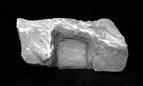
Object type: Base/Socket stone
Measurements: H. max. 29 cm (11.5 in); W. 28 cm (11 in); D. 15 cm (6 in)
Stone type: Greyish orange pink (10R 8/2) to pale red (5R 6/2), bedded, clast-supported, quartz sandstone. Thin, individual beds vary from moderate to poorly sorted. The sub-angular to sub-rounded clasts vary from 0.3 to 1.0 mm, but are dominantly in the range 0.4 to 0.5 mm. The clasts are dominantly quartz, but a few pinkish feldspars and a few flakes of white mica are present. Helsby Sandstone Formation, Sherwood Sandstone Group, Triassic (C.R.B.)
Plate numbers in printed volume: Ills. 329–34
Corpus volume reference: Vol 13 p. 215
(There may be more views or larger images available for this item. Click on the thumbnail image to view.)
A (top): Apparently originally roughly dressed, this face presents no carving; it was cut away at the centre to form a deep slot (12 cm / 4.8 in) wide, running nearly all the way through the depth of the stone. The stone has been sheared off across this slot.
B, C and D (narrow): Broken and roughly dressed
E (narrow): Broken, with the remains of the slot in profile
F (bottom): Broken and roughly dressed, this face of the stone protrudes slightly over the cutting of the slot, suggesting that it formed a ridge providing further support for the element inserted into the slot.
Although undecorated, this piece evidently formed the base of a sculptural monument to which it was attached by means of a tenon-and-mortice joint. The slight ridge formed on C was likely intended to provide further support for that tenon. Clearly the date of the monument cannot be ascertained, but this piece does provide further evidence for the numerous and varied sculptural monuments that were displayed at Repton.
