Select a site alphabetically from the choices shown in the box below. Alternatively, browse sculptural examples using the Forward/Back buttons.
Chapters for this volume, along with copies of original in-text images, are available here.


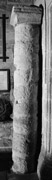
Object type: Columns with capitals and bases
Measurements:
20a. North. Base:
H. 27 cm (10.6 in); W. 68 cm (26.8 in); D. 52 cm (20.5 in)
Column: H. 57 cm (22.4 in); Diameter 43 cm (16.9 in)
South. Base:
H. 29 cm (11.4 in); W. 54 cm (21.3 in); D. 53 cm (20.9 in)
Column: H. 69 cm (27.2 in); Diameter 39 cm (15.4 in)
20b. Both columns. Overall
H. 268 cm (105.5 in)
Column. H. 243 cm (95.7 in) Circumference 134 cm (52.8 in)
Capital. H. 25 cm (9.8 in) W. 49 cm (19.3 in) D. 48 cm (18.9 in)
Stone type:
20a. Because of surface covering, it is difficult to find a fresh face and not possible to ascertain the colour of the base and column remains by the south entrance to the crypt; that on the north is a yellowish grey (7/2), well sorted, clast-supported, quartz sandstone. Both are well sorted, clast-supported, quartz sandstone. The sub-angular to sub-rounded grains range from 0.2 to 0.4 mm across, but are dominantly 0.3 mm across. Helsby Sandstone Formation, Sherwood Sandstone Group, Triassic (C.R.B.)
20b. Yellowish grey (7/2), well sorted, clast-supported, quartz sandstone. The sub-angular to sub-rounded grains range from 0.2 to 0.3 mm across. Helsby Sandstone Formation, Sherwood Sandstone Group, Triassic (C.R.B.)
Plate numbers in printed volume: Ills. 369–370, 367–368
Corpus volume reference: Vol 13 p. 223-224
(There may be more views or larger images available for this item. Click on the thumbnail image to view.)
20a. Inside church, at east end, by north and south entrances to crypt
20b. Standing on either side of the entrance into the church in the south porch
20a. Damaged but in generally good condition
20b. Good, with capital resting on uppermost drum of column
20a. Column bases and lower part of columns (Ills. 369–70)
Although Cox’s 1886 drawing shows the lower parts of the columns consisting of two drums resting on top of each other, the present remains consist only of single drums resting on rectangular bases, of a depth comparable to each other. The upper edges of the column remains are roughly broken in a manner compatible with that illustrated by Cox, and the surfaces have been much hacked. The bases stand on the original floor level of the eastern end of the church.
20b. Columns with capitals (Ills. 367–8)
Both west and east columns consist of nine drums each, well dressed, that are of the same diameter, showing no signs of entasis. The square capitals rest directly on the uppermost drum, with no sign of transition from column to capital. The capitals widen out from a single narrow roll moulding at the base, by means of a plain out-curved moulding, to the upper faces which are divided by grooves to form three narrow mouldings. Traces of gesso and red paint are preserved in the grooves between the mouldings.
These columns, present in a nineteenth-century illustration of the nave and chancel of the church by R.M. Gorham, a pupil at Repton School (Taylor 1989, fig. 2), indicate that they were originally constructed as a series of drums set one on top of the other as they currently survive, suggesting that they may have been derived from Roman fabric, but their capitals, squared and reeded, are not of Roman construction and likely represent Anglo-Saxon features of a date contemporary with the capitals set above the pilasters and columns in the crypt (Repton 19b–c). Like the central columns of the crypt they were also coloured, retaining traces of red on white polychromy, and so speak to the elaborate nature of the decorated interior of the church in its eighth- or ninth-century phase of construction.
