Select a site alphabetically from the choices shown in the box below. Alternatively, browse sculptural examples using the Forward/Back buttons.
Chapters for this volume, along with copies of original in-text images, are available here.


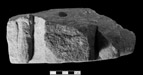
Object type: Cross-head fragment
Measurements: H. 14 cm (5.5 in); W. 22 cm (8.65 in); D. 8 cm (3.2 in)
Stone type: Pale red (5R 6/2), moderately to well sorted, clast-supported, quartz sandstone. The sub-angular to sub-rounded clasts vary from 0.3 to 0.6 mm, but are dominantly in the range 0.4 to 0.5 mm. The clasts are dominantly quartz, but a few pinkish feldspars are present. Helsby Sandstone Formation, Sherwood Sandstone Group, Triassic (C.R.B.)
Plate numbers in printed volume: Ills. 311–22; Fig. 43a–c
Corpus volume reference: Vol 13 p. 212-214
(There may be more views or larger images available for this item. Click on the thumbnail image to view.)
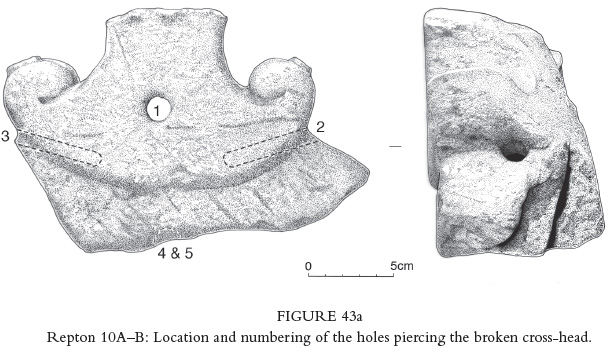
A (broad): Taken as the ‘front’ of the piece, the carving consists of the arm of a plain, finely dressed, ‘hammer-head’ cross composed of pelta-shaped arms with curled terminals (type E9: Cramp 1991, fig. 2). A small fragment of stone, more roughly dressed, extends, at a lower plain, from the outer edge of the cross-arm; it is unclear whether this represents secondary damage or, more likely, indicates that the stone was originally only roughly dressed at this point. The centre of the cross-arm is pierced by a finely drilled hole, Hole 1 (15 mm diameter), that extends the surviving thickness of the stone to exit on C (see Fig 43a for the location and numbering of the holes).
B (narrow): Understood to form the original ‘right-hand side’ of the piece, the area corresponding to the roughly dressed section of A seems to have continued onto B on the right where it is also broken away. Two-thirds of the way along this face the undressed section terminates in a slight indentation, on the other side of which is the smooth dressed surface of the (back of the) scroll. A finely drilled hole, Hole 2 (15 mm in diameter), enters the stone below the scroll and descends to a depth of 4 cm at an angle of approximately 50o to the horizontal, complementing that drilled into D.
C (broad): The stone is broken on this face, understood to be the ‘back’ of the piece, but the outlines of the scrolls and tapering squared feature apparent on A are preserved. The drilled hole from A, Hole 1, emerges broken off two-thirds of the way down from the upper edge.
D (narrow): Forming the ‘left side’ of the cross-head, this face is badly broken, but the outline of the scrolled feature on A is preserved, as is the dressed edge of the tapered squared section, on the right. A finely drilled hole, Hole 3 (15 mm in diameter) enters the stone below the scroll, and descends to a depth of 4 cm at an angle of approximately 50o to the horizontal, complementing that drilled into B.
E (top): The stone is broken through the upward projection of the lower arm of the cross; the scrolled left terminal of the pelta is intact; the greater part of the scrolled right terminal is missing.
F (bottom): All original surface destroyed. Traces of two further holes are preserved in the broken face: Hole 4, broken in half longitudinally, penetrates from the broken back to a depth of about 4 cm towards A. The hole preserves grooves resulting from the action of the drill. Hole 5, which penetrates vertically into F at 90o, survives only as the tapered end of the hole made by the drill.
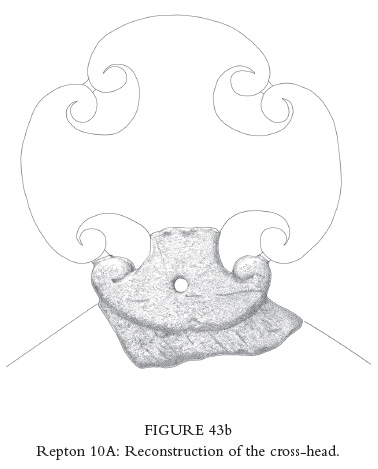
Although fragmentary, this is an unusual piece that preserves evidence of the use of a drill in forming holes in carved stones of early medieval England, evidence that is rare (but see above, Repton 1D, p. 201) in this period.[1] It seems to have been part of an elaborate stone monument incorporating a cross-head with pelta-shaped arms featuring scrolled terminals and curved armpits (Fig. 43b). The cross-head can be approximately, but not precisely, matched in metalwork of the ninth century, most closely perhaps in the detail of the largest of the disc brooches from the Pentney hoard of the first third of the ninth century (Webster and Backhouse 1991, 229-31, fig. 187c); in an openwork disc brooch from the Beeston Tor hoard, deposited c.875 (ibid. 269-70, fig. 245a), and in the so-called Canterbury Cross of the mid-ninth century (Jessup 1974, 54-6, pl. 3.2).
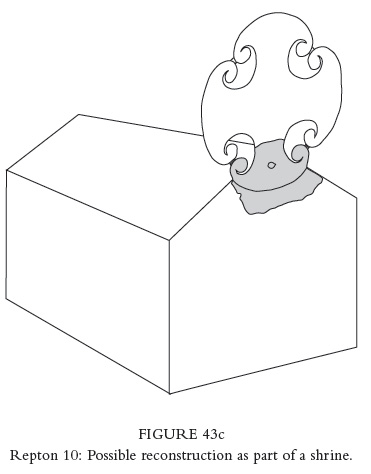
The carefully drilled holes further suggest that it was designed to hold multi-media attachments that extended through its width and at angles from its sides. Together with the fact that it was attached to a more roughly dressed element, these features suggest that it may have functioned as an elaborate finial, possibly for a house-shaped shrine (Fig. 43c). As is well known, Chad’s body was placed in just such a monument, initially made of wood (Bede, HE iv.3; Colgrave and Mynors 1969, 346) which was subsequently, in the early ninth century, enshrined in an elaborate stone version apparently echoing the house-shaped form of the original monument (see Lichfield 1). A comparable cenotaph of eleventh- or twelfth-century date survives at Clones in Co. Monaghan which, associated with St Tighernach, is generally understood to be based on an earlier wooden and metal shrine housing the saint; it is decorated with elaborate finials at its gable ends (Harbison 1999; and see Ill. 653).
