Select a site alphabetically from the choices shown in the box below. Alternatively, browse sculptural examples using the Forward/Back buttons.
Chapters for this volume, along with copies of original in-text images, are available here.


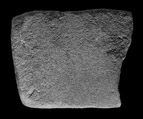
Object type: Cross-head fragment
Measurements: H. 11 cm (4.33 in); W. 8.5 cm (3.35 in); D. 8 cm (3.15 in)
Stone type: Greyish orange pink (5YR 7/2), clast-supported quartz sandstone. Clasts, dominantly of quartz, vary from sub-angular to subrounded, and range from 0.2–0.4 mm, but are dominantly 0.3 mm across. Small fragments of white quartz form about 2% of the rock. Helsby Sandstone Formation, Sherwood Sandstone Group, Triassic (C.R.B.)
Plate numbers in printed volume: Ills. 299–306
Corpus volume reference: Vol 13 p. 211
(There may be more views or larger images available for this item. Click on the thumbnail image to view.)
A (broad): Much of this face has been broken off, leaving the upper quadrant of the original decoration. This consists of a lightly incised narrow flat outer moulding demarcating the upper left-hand corner, inset with a slightly narrower inner flat moulding. The decoration contained by these borders consists of the remains of a coherently formed, but equally lightly incised, key pattern to the right of which is a circular feature, the nature of which is too incomplete to ascertain.
B (narrow): Broken
C (broad): Most of this face has sheared off; the remains are well dressed but undecorated.
D (narrow): This face is very well dressed but undecorated.
E (upper): Well-dressed but undecorated
F (lower): Lost by the break in the stone
Although small and fragmentary, this piece likely represents the remains of the end of a cross-arm which was decorated with key-patterning, articulated in a technically accomplished manner, on one face. Carved from the same stone type as used for the other pieces recovered from the site, it represents yet another piece of an elaborate monument, probably a high cross, that was set up across the site during the pre-Viking period. The very severe damage, reducing the piece to no more than a small cube, is comparable to that inflicted on other pieces (e.g. Repton 2-5 from stone setting over Graves 511/295), and may reflect the deliberate breaking up of the carved stone monuments around the site during the latter half of ninth century (see Chapter V, pp. 56-7).
