Select a site alphabetically from the choices shown in the box below. Alternatively, browse sculptural examples using the Forward/Back buttons.
Chapters for this volume, along with copies of original in-text images, are available here.


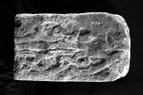
Object type: Shaft fragment reused as lintel
Measurements: H. 42 cm (16.5 in); W. 31 cm (12.25 in); D. 23 cm (9 in)
Stone type: Very pale orange (10YR 8/2), very poorly sorted, clast-supported quartz sandstone. The sub-angular to sub-rounded grains range from 0.3 to 1.5 mm across, with a few scattered clasts up to 3 mm. Quartz predominates, but there are a few scattered pale pink feldspars. Ashover Grit?, Marsden Formation, Millstone Grit Group, Carboniferous (C.R.B.)
Plate numbers in printed volume: Ills. 289–95
Corpus volume reference: Vol 13 p. 210-211
(There may be more views or larger images available for this item. Click on the thumbnail image to view.)
A (broad): Finely dressed with a round arch,16 cm wide and 8 cm high (6.25 x 3.2 in), inset with a plain rebate, 3 cm wide (1.25 in), cut into it.
B and D (narrow): Cut back so that no carving survives.
C (broad): Dressed back and cut with wide splay for window opening
E (top): The top of the stone preserves carved decoration in the form of a series of curling strands set on either side of a thin rounded vertical moulding that traverses the face; the width of this is not regular but rather, undulates along its length. The surface of the carving is badly damaged and broken in places, particularly on the left, but the strands seem to have been marked by a central incision and curled at the terminals or where they intersect with each other. The right-hand edge may have been bounded by a thin rounded edge moulding.
F (lower face): Finely dressed splayed round-headed opening of window
The stone, originally a cross-shaft of considerable dimensions, was apparently broken up and this portion reused as a window lintel. When this occurred is unclear. The form of the decoration suggests that the monument itself was likely tenth-century in date, with its centrally incised strands of interlace, and the loose nature of its overall design which is found across the region (see Chapter VII).
