Select a site alphabetically from the choices shown in the box below. Alternatively, browse sculptural examples using the Forward/Back buttons.
Chapters for this volume, along with copies of original in-text images, are available here.


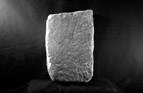
Object type: Cross fragment
Measurements: H. 30 cm (11.75in); W. 25.5 cm (10 in); D. 20 cm (7.9 in)
Stone type: Greyish orange pink (10R 8/2) to pale red (5R 6/2), moderately sorted, clast-supported, quartz sandstone. The sub-angular to sub-rounded clasts vary from 0.3 to 0.5 mm, but are dominantly 0.4 mm across. The clasts are dominantly quartz, but a few white feldspars are present. Helsby Sandstone Formation, Sherwood Sandstone Group, Triassic (C.R.B.)
Plate numbers in printed volume: Ills. 296–8
Corpus volume reference: Vol 13 p. 210
(There may be more views or larger images available for this item. Click on the thumbnail image to view.)
A (broad): Although roughly dressed and broken, the remains of a wide flat edge moulding preserved in low relief runs vertically down the length of the stone on the left; it may also have extended along the upper edge. To the right is an area of dressed ground on which are the remains of two curved bands that intersect in the middle of the stone. It is unclear whether these formed part of an interlace pattern or, more likely, represent the ribbon-like extensions characteristic of animal art.
B (narrow): Broken and roughly dressed
C (broad): Although badly damaged, the remains of a wide flat edge moulding preserved in low relief can be detected running vertically down the right-hand edge of the stone. No sign of any carving remains.
D (narrow): Roughly dressed
While so little remains of the carving that likely decorated this stone, it is probable that it represents the remains of a cross-shaft, and with the moulding apparently running along the upper edge it may have been the upper portion of the shaft, but equally, this may simply mark the upper frame of a panel. In either case, the quality of the carving evident in what remains of the moulding and the fragmentary interlaced strands indicates that the monument was once an impressive piece of sculpture. The flat nature of the edge moulding, in itself, provides little indication of the date of the monument; such mouldings were used in this region throughout the ninth and tenth centuries and interlace patterns are ubiquitous; if the fragmentary strands are those of zoomorphic interlace this could equally suggest a date in the ninth or tenth centuries.
