Select a site alphabetically from the choices shown in the box below. Alternatively, browse sculptural examples using the Forward/Back buttons.
Chapters for this volume, along with copies of original in-text images, are available here.


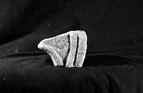
Object type: Cross-head fragment
Measurements: H. 9.5 cm (3.7 in); W. 7 cm (2.8 in); D. 8 cm (3.1 in)
Stone type: Greyish orange (10YR 7/4), poorly sorted, clast-supported, quartz sandstone. The sub-angular to sub-rounded clasts mostly vary from 0.3 to 1.2 mm, but are dominantly in the range 0.5 to 0.8 mm. The clasts are dominantly quartz, but pinkish feldspars are present. Millstone Grit Group, Carboniferous (C.R.B.)
Plate numbers in printed volume: Ills. 281–8
Corpus volume reference: Vol 13 p. 209-210
(There may be more views or larger images available for this item. Click on the thumbnail image to view.)
A (broad): The outer edge is curved and the interior pierced to the lower right by a large rounded opening. A curved length of raised roll moulding about 1 cm (0.4 in) wide, expanding slightly towards the upper right, runs around the surviving left quadrant of the interior opening. This inner moulding converges at its upper end with the inner of two raised mouldings. These run parallel with each other around the curved outer edge of the stone giving the appearance of a median-incised band. The outer moulding is a little flattened and about 1.5 cm wide, the inner slightly narrower. The V-shaped area of recessed ground to the left between the mouldings is well dressed with a gently rounded surface rising from incised grooves along the edges of the curved mouldings. There is no sign of decoration.
B and D (narrow): Broken
C (broad): The same set of mouldings as on A are preserved in mirror-image, with the V-junction to the right. There is a line of damage to the right of the stone across the two outer mouldings, the inner moulding, and the recessed ground between them.
E (top): The curved outer surface is well preserved, about 7.5 cm (2.75 in) wide.
F (bottom): The interior opening is well preserved. The opening flares out slightly towards both faces on a gentle curve, so that the size of the opening was less at the centre of the stone than to either side. The edge against C is damaged.
This piece may well represent the remains of a cross-head with a plain face surrounded by simple mouldings which are assured and precise. Such cross-heads ‘have a long history in Anglian art’ (Bailey, in Bailey and Cramp 1988, 77, discussing Brigham 7 in Cumberland). It may thus be a fragment of one arm of a wheel-headed cross, but not enough survives to be certain. A ring continuing the double moulding along the curved outer edge of the head could have been on the same plane as the existing double moulding, or a recessed plain ring of type 2b (Cramp 1991, fig. 3) as at Brigham (Bailey and Cramp 1988, ills. 152–5), datable to the tenth or eleventh century.
Alternatively, Repton 6 may represent part of the arm of a cross-head without a ring, with double-mouldings along the outer edges of the arm, and a single moulding along the inner edges. Such a cross-head also comes from Brigham, dated to the tenth or eleventh century (Bailey and Cramp 1988, no. 6, ills. 148–51). The Whitby crosses tend to have incised rather than moulded detail around the edges, and when they have mouldings these are more delicate, either plain or combined with cable mouldings (e.g. Lang 2001, 231–48, ills. 897–902). Repton 6 thus seems to have been of type B10 (Cramp 1991, fig. 2), but it could equally have been of hammer-head type, such as Osmotherly 3, north Yorkshire (Lang 2001, ills. 720, 723), datable to the first half of the tenth century. The type E10 cross-head with a type B ring from Topcliffe (1), north Yorkshire (Lang 2001, ills. 814–18), may however offer the best parallel. It is datable to the first half of the tenth century and seems as well-carved as Repton 6. But it is possible that no. 6 could date to before 873-4, on the basis that the breakage of the head suggests that it may have been carved prior to the Viking wintering of that date.
