Select a site alphabetically from the choices shown in the box below. Alternatively, browse sculptural examples using the Forward/Back buttons.
Chapters for this volume, along with copies of original in-text images, are available here.


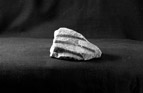
Object type: Carved fragment
Measurements: H. 9.5 cm (3.7 in); W. 5.5 cm (2.2 in); D. 5 cm (2 in)
Stone type: Pale yellowish brown (10YR 6/2), well sorted, clast-supported, quartz sandstone. The sub-angular to sub-rounded clasts vary from 0.2 to 0.4 mm, but are dominantly 0.3 mm across. The clasts are dominantly quartz, but a few pink feldspars are present. Helsby Sandstone Formation, Sherwood Sandstone Group, Triassic (C.R.B.)
Plate numbers in printed volume: Ills. 275–80
Corpus volume reference: Vol 13 p. 208-209
(There may be more views or larger images available for this item. Click on the thumbnail image to view.)
A (?broad): Four stepped flat ribs cover this face. These have a slightly curved surface and curve from bottom to top. Each rib could be widening towards the upper, pointed end of the stone. From the left: the upper rib is 1.5 cm (0.6 in) wide, then damaged; the second, 0.9 cm (0.4 in) wide at the base and 1.1 cm (0.4 in) at the top; the third 0.8 (0.3 in) wide at the base and 1.1 cm (0.4 in) wide nearer the top (where it is damaged by a cut), with a high 1.1 cm (0.4 in) step down to the last surviving rib on the right. The lowest rib seems to have a steeper curve from bottom to top, but only survives at its full width of 0.9 cm (0.4 in) at 1.5 cm (0.6 in) from the bottom.
B–F: Broken
This piece could have been part of a capital like that from St Augustine’s, Canterbury (3), where the volutes are joined by ‘a band carved as if it was composed of several overlapping layers which curves down in a swag to pass below a rosette’ (Tweddle et al. 1995, 131–2, ills. 29–32; cf. the less well preserved no. 4, ills. 33, 35–36). The ornament on the abacus of the Canterbury capital is about the same width as Repton 5, which could alternatively have been part of a vertical leaf like those on the circular body of the Canterbury capitals. Alternatively, the four ribs of the Repton piece might represent folds of drapery as on Reculver 1 (Tweddle et al. 1995, 151, ills. 113, 115), on which the size of the folds is about the same as on Repton 5; the stylised ribbed drapery featured on the late eighth-century Rothbury (1) cross provide another parallel (Cramp 1984, 217–21, pl. 214.1220). There are other possibilities but the remains represented by Repton 5 are too fragmentary to encourage further speculation.
