Select a site alphabetically from the choices shown in the box below. Alternatively, browse sculptural examples using the Forward/Back buttons.
Chapters for this volume, along with copies of original in-text images, are available here.


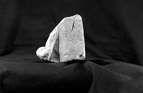
Object type: Shaft fragment
Measurements: H. 11 cm (4.3 in); W. 11 cm (4.3 in); D. 11 cm (4.3 in)
Stone type: Greyish orange pink (5YR 7/2), moderately to well sorted, clast-supported, quartz sandstone. The sub-angular to sub-rounded clasts mostly vary from 0.2 to 0.4 mm, but are dominantly 0.3 mm across. The clasts are dominantly quartz, but pinkish feldspars and a few flakes of white mica are present. Helsby Sandstone Formation, Sherwood Sandstone Group, Triassic (C.R.B.)
Plate numbers in printed volume: Ills. 269–74
Corpus volume reference: Vol 13 p. 208
(There may be more views or larger images available for this item. Click on the thumbnail image to view.)
A (?broad): Along the right edge there is a broad flat raised moulding, 4.4 cm (1.7 in) wide, dressed to a smooth surface, sloping down to the left to a small area of well-dressed flat ground from which a raised rounded moulding runs diagonal to the edge moulding.
B (?narrow): A plain well-dressed surface 11 cm (4.25 in) wide with superficial damage. The right-angle to A on the left is carefully formed and hardly worn; the right-angle to C is rounded, but the junction to the broken F is sharp. The top edge is rounded and worn to an angle.
C (broad): A small area of flat plain surface, c. 6 cm (2.5 in) wide, with a rounded angle on the left to B, a heavily worn and rounded diagonal upper edge, and a sharp broken edge to F.
D (narrow): Missing, the surviving surface broken, battered, and heavily worn
E (top): Broken and worn
F (bottom): Rough, broken, but fresh
Apparently part of a carved shaft with a recessed decorated panel on A and a plain narrow face B. The small surviving area of C could be part of a broad flat edge moulding as on A, but appears to be wider. The small moulded area on A may be curving. There is nothing to suggest that this fragment is part of the same monument as Repton 2, but it is not unreasonable to assume that it is.
