Select a site alphabetically from the choices shown in the box below. Alternatively, browse sculptural examples using the Forward/Back buttons.
Chapters for this volume, along with copies of original in-text images, are available here.


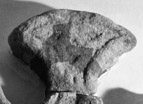
Object type: Cross-arm
Measurements: H. 19 cm (17.5 in); W. 26 > 9 cm (at arm pit) (10.25 > 3.5 in); D. 9.5 cm (3.75 in)
Stone type: Medium-grained, well-sorted, light brown (5YR 6/6) feldspathic sandstone, with sub-angular quartz grains dominant and small amounts of feldspar. Some quartz clasts up to 1 mm across. Namurian sandstone, either distinct from that of the lower section, or from the same variable stratum. Millstone Grit Group, Carboniferous (R.T.)
Plate numbers in printed volume: Ills. 237–9, 242
Corpus volume reference: Vol 13 p. 195-196
(There may be more views or larger images available for this item. Click on the thumbnail image to view.)
Decorated on all four faces although the sides are badly worn.
A (broad): Decorated with the terminal of a two-stranded knot of interlace forming a pair of V-shaped loops resembling a ‘triquetra’ design. The strands extend to the armpit of the cross-head where the arm is truncated. A rounded edge moulding frames the piece.
B (narrow): Due to weathering and wear the carving is indistinct, but appears to incorporate a protrusion at the centre which is difficult to interpret. It too appears to have had a rounded edge moulding.
C (broad): Edged by a rounded moulding, the decoration seems to have been decorated in a manner similar to A, but it is too worn to decipher with any certainty.
D (narrow): This face is too worn and weathered to identify the carved detail.
This is part of a type E9/10 cross-head with rounded armpits and wedge-shaped terminals when complete, a type found in several locations in the region: at Rowsley (1) and Elton Moor (1, now missing) in Derbyshire, and Leek (5) in Staffordshire (see Ills. 192-5, 408-9, 579-81). In these instances a two-stranded interlace pattern terminating in V-shaped loops extends from a central boss, an arrangement that perhaps provides an explanation of the original layout of the cross-head of which this arm was originally a part. One Ash 2 (below) preserves the remains of a central feature, and although it is not certain that it originated from the same cross as One Ash 1, it does share a similar edge moulding and is of the same stone type, suggesting at the very least that they would complement each other as parts of a single cross-head. The protrusion on B, however, is difficult to explain: it may suggest a rather unusual decorative feature; the remains of an (abortive) ring linking the cross-arms (which is entirely absent from One Ash 2); or may even suggest that the arm was unfinished.
Along with One Ash 2 the fragment was discovered in a non-ecclesiastical context close to a medieval grange (One Ash Grange), although this formed part of the estates of Roche Abbey in south Yorkshire. Thus, while the earthworks of a deserted medieval settlement nearby, at SK 165648 (Derbyshire HER 10265), may relate to the original location of the cross, this may further suggest that the land later incorporating the Grange and the Cistercian abbey estates had earlier ecclesiastical associations.
