Select a site alphabetically from the choices shown in the box below. Alternatively, browse sculptural examples using the Forward/Back buttons.
Chapters for this volume, along with copies of original in-text images, are available here.


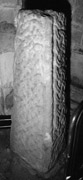
Object type: Part of shaft
Measurements: H. 117 cm (46 in); W. 38 > 26 cm (14 > 10.25 in); D. 30 > 21 cm (12 > 8.25 in)
Stone type: Well-sorted, medium-grained (0.3 to 0.5 mm) light brown (5YR 6/6) sandstone. Grains dominantly quartz, some well-rounded, others sub-angular. Helsby Sandstone Formation, Sherwood Sandstone Group, Triassic (R.T.)
Plate numbers in printed volume: Ills. 230–2
Corpus volume reference: Vol 13 p. 194-195
(There may be more views or larger images available for this item. Click on the thumbnail image to view.)
Being cemented to the floor close to the church wall makes the carving on D particularly difficult to see, though it can still be seen with the use of a mirror. But it is not possible to photograph the carving on C. The edges of the shaft are formed by cable mouldings with alternate wide and narrow strands; that between C and D is damaged and has lost its definition.
A (broad): A complete interlace pattern using four strands, each of which is divided into two by a median-incised line. The pattern forms a repeated series of mirrored turned loops (complete pattern E: Cramp 1991, fig. 14), which diminish in width towards the top according to the taper of the shaft. The pattern is truncated at the top and base, and the edge mouldings are damaged especially on the left.
B (narrow): This face contains a four-stranded interlace pattern with median-incised strands (simple pattern F: Cramp 1991, fig. 23) which is truncated at the top and bottom where the pattern has been dressed off. It too diminishes in width as the shaft tapers towards the top.
C (broad): The damage and wear sustained to this face means only the upper third or so of the carving is clearly visible. This forms a four-stranded interlace with double strands which is truncated at the top and worn/damaged at the bottom. The strands terminate in loops turning the strands back on themselves. Below is the outline of a figure of which only the upper part survives. It appears to have upraised arms which touch the lower extremities of the interlace above; the exact relationship is unclear. The head seems to face to the left, although this impression may be due to damage. The hair around the top of the head is articulated as a series of close curls, like those featured on Norbury 1.
D (narrow): As face B. There appears to be a terminal at the bottom of the interlace but, due to excessive damage to the shaft, this is uncertain.
The extant carving is relatively well-executed and, as with Norbury 1, suggests significant investment on the part of those responsible for its production. Again, the decorative scheme is typical of Viking Age sculpture with the extensive use of interlace patterns on all faces. The complex pattern on A is of a type which is found concentrated in the Dove Valley region, at Ilam (1), Alstonefield (1) and Checkley (1), dated to the tenth century. Likewise, the figure on C, with its upraised arms, is also found at Ilam (1) and Checkley (1) and may reflect local expression, suggesting collusion with the carvers or patrons in that region.
