Select a site alphabetically from the choices shown in the box below. Alternatively, browse sculptural examples using the Forward/Back buttons.
Chapters for this volume, along with copies of original in-text images, are available here.


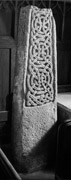
Object type: Part of shaft
Measurements: H. 165 cm (65 in); W. 40 > 27 cm (15.75 > 11 in); D. 26 > 21 cm (10.25 > 8.25 in)
Stone type: Well-sorted, medium-grained (0.3 to 0.5 mm), light brown (5YR 6/6) sandstone. Grains dominantly quartz, some well-rounded, others sub-angular. Helsby Sandstone Formation, Sherwood Sandstone Group, Triassic (R.T.)
Plate numbers in printed volume: Ills. 233–6
Corpus volume reference: Vol 13 p. 193-194
(There may be more views or larger images available for this item. Click on the thumbnail image to view.)
This is part of a cross-shaft with the bottom third (approximately) being plain on all faces, probably to stand in a socket or in the ground. Complete panels survive on A, C and D, and a near-complete panel on B. The shaft is incomplete with the top missing, but the latter may have contained the base of a cross-head. All four faces are edged by a roll moulding carved in high relief and separated from the decoration which is likewise articulated in high relief on a dressed-back field.
A (broad): An interlace pattern composed of three encircled knots, each joined by four strands all of which are marked by a median incision. The lowest consists of three closed rings linked to the others and enclosed by a four-stranded interlace. The upper two consist of two closed rings, again linked and enclosed by a four-stranded interlace (closed circuit pattern C: Cramp 1991, fig. 24). The scheme terminates at the base by means of alternate joining strands. At the top is a terminal that appears similar to that at the base of the panel but this area is damaged and it may be a thin two-strand plait as on D.
B (narrow): The upper portion of this face contains a four-stranded interlace pattern with median-incised strands (simple pattern F: Cramp 1991, fig. 23). The roll moulding on the left seems to cross vertically across the shaft just below the break in the stone suggesting this represents the extent of the pattern, but damage at this point means the upper terminal is missing. At the bottom the interlace terminates in a closed loop on two of the strands with the other two diverging above the head of a figure which fills the remainder of the panel below. One strand is extended and loops back over the figure’s head. The figure stands, facing forwards, with the legs turned to the right, the knees flexed, and the feet, resting on the base of the panel, posed as if in the act of walking to the right. Below the terminal of the second strand is an object which appears to be a horn extending from the mouth of the figure (see below). His head is well modelled and slightly ovoid, with short hair arranged as a series of ‘curls’ around the head, and round eyes with drilled pupils. He wears a short tunic of a type sometimes described as a kirtle, with acute dropping corners and an inverted V-shaped hemline. This is decorated below the waist by a series of incised lines echoing the shape of the skirt; above the waist two dominant pellets over the chest are echoed by further incised lines, suggesting a breast-plate. The figure’s right arm hangs down towards a long flat object that extends diagonally (from right to left) across his waist, probably representing a sword. His left arm is upraised towards a curved object with a pointed lower end close to his mouth that extends above the figure’s head, echoing the curvature of the interlace strand on the other side; this can be understood to represent a horn.
C (broad): Partially obscured by the proximity of the shaft to the church wall, this face is decorated by a ten-cord simple interlace pattern of median-incised strands, which terminates in alternate joining closed strands. The top of the panel is separated from the decoration above by a thin two-cord plait moulding with part missing.
D (narrow): Again, partially obscured by the shaft’s proximity to the church wall, this face is damaged so that only the upper third or so is clearly visible. It is decorated by an irregular three-stranded half-pattern interlace with median-incised strands, the width of which varies giving one strand a serpentine appearance. Indeed, Allen (1903, 100) described this as distinctly ‘zoomorphic’ with a mouth and tail, although these are now difficult to discern. One part of the interlace displays a series of closed loop designs known as a ‘Stafford knot’ (simple pattern E). The pattern terminates in two cross-joined loops and is separated from the decoration above by a thin two-stranded plait moulding.
The carving, in high relief, is relatively well-executed perhaps suggesting considerable investment on the part of the patron in its production. The decorative repertoire is typical of Viking Age sculpture in the region with the extensive use of interlace patterns on A, C and D. The irregular form of the interlace on D, with one strand thicker than the others, is comparable with motifs preserved at Hope (1), or Ilam (1) and Leek (1) in Staffordshire, which can be dated to the tenth century. The figure is clearly a warrior, apparently in battle dress, displaying his sword and horn. It may depict the individual commemorated by the monument, either as a member of the warrior elite in life, or as the warrior ideal aspired to in the afterlife. Alternatively, it may have been intended to depict Heimdallr the Norse god, or a similar ‘deity’ from the belief systems of other Germanic peoples. Whatever his name, the Heimdallr figure was understood to stand by the Bifrost Bridge, guarding entry to Æsir or Asgard. The important attribute of this character was his horn, Gjallarhorn, with which he could alert the gods at the onset of Ragnarök (Branston 1974, 145). It may be that the figure commemorated this deity, or he was being implicitly invoked by reference to the protective role of the individual memorialised by the monument.
