Select a site alphabetically from the choices shown in the box below. Alternatively, browse sculptural examples using the Forward/Back buttons.
Chapters for this volume, along with copies of original in-text images, are available here.


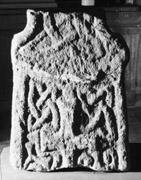
Object type: Part of shaft with remains of cross-head
Measurements: H. 43 cm (16.9 in); W. 32 > 28 cm (12.6 > 11 in); D. 15.5 > 12.5 cm (6.1 > 4.9 in)
Stone type: Greyish orange pink (5YR 7/2), moderately sorted, medium-grained sandstone with the sub-angular to sub-rounded clasts ranging from 0.3 to 0.6 mm, but dominantly 0.3–0.5 mm. Some white/pink barites present. Roaches Grit–, Marsden Formation, Millstone Grit Group, Carboniferous (C.R.B.)
Plate numbers in printed volume: Ills. 575–8
Corpus volume reference: Vol 13 p. 299-300
(There may be more views or larger images available for this item. Click on the thumbnail image to view.)
A (broad): The shaft is decorated with a panel containing the upper and horizontal arms of a cross in the centre, with the lower arm truncated; the others have wedge-shaped terminals (type B6: Cramp 1991, fig. 2). The centre may have been decorated by a raised motif, but this is now too worn to decipher clearly. On either side of the upper arm are closed-circuit patterns comprising two inter-linked loops; neither is symmetrical and both are of different widths. Below each of the horizontal arms are further patterns. However, only the tops are visible and it is not now possible to decipher their form.
The panel is bounded across the top by a curved moulding which forms the junction between the shaft and the cross-head, of which only part of the lower cross-arm survives with the arm-pits visible on either side. It nevertheless suggests that the cross-head was of the type with curved terminals (type E8 or E11; Cramp 1991, fig. 2). It is decorated with an interlace pattern which is now badly worn, but appears to be the cross-joined terminals of a three- or four-strand simple interlace. Enclosing it is a thin edge moulding.
B (narrow): This face is decorated with a panel of line or key pattern comprising three vertical strands. There is one complete register and a small part of another, below. On either side are flat-band or rolled edge mouldings with a small strand joining the edge moulding to the line pattern. Above is the damaged end of an arm-pit of the cross-head.
C (broad): Decorated with a central strand extending from the bottom of the truncated panel. It terminates at the top inside two concentric rings, encompassing the top part of the vertical strand. There are outer strands on each side of the rings, both bending to the left. There appear to be two pellets at the bottom, one on each side of the central vertical strand. From the top of the concentric rings, strands emerge to join a curved moulding separating the shaft from the cross-head. There is a further pellet at the top right-hand side of the outer strand. There are rolled or flat-band mouldings on each side of the panel.
Above this panel is the lower part of the cross-arm which is undecorated but with a small hole in the centre which is probably a later addition. There is an edge moulding around the outside of the cross-arm. The cross-head arm-pits can be seen on either side of the cross-arm; the upper part is broken away.
D (narrow): This face is again decorated with a panel of line or key pattern comprising three vertical strands which stem from the edge moulding on each side; two complete registers survive. On either side of the pattern are flat-band or rolled edge mouldings which are part of the complete line pattern. Above is the damaged end of the cross-head above, which is an arm-pit.
This is a particularly asymmetrical shaft where the decoration, especially on A and C, appears not to be well crafted. C displays an abstract design bearing similarities with Bakewell 21 (Ill. 52) and some pieces in Cumbria, for example, Addingham 1A and 1C, and St Bees 2A (Bailey and Cramp 1988, 45–6, 145–6, ills. 1, 3, 551). The use of a cross as the central design element on A is unusual, especially in conjunction with the other designs and patterns. The use of a line pattern on the narrow faces is a feature often associated with round-shaft crosses (as with Alstonefield 7 and Ilam 2), but this piece is unlikely to have been of this form since its dimensions suggest a rectangular-sectioned shaft. The cross-head is of the curved type (see e.g. Leek 5 below, and Rowsley 1, Derbyshire), often associated with the crosses of the Pennine fringes through their decorative patterns, most of which appear to be from the tenth century.
