Select a site alphabetically from the choices shown in the box below. Alternatively, browse sculptural examples using the Forward/Back buttons.
Chapters for this volume, along with copies of original in-text images, are available here.


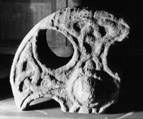
Object type: Part of cross-head
Measurements: H. 34 cm (13.4 in); W. 35 cm (13.8 in); D. 13 cm (5.1 in)
Stone type: Greyish orange pink (5YR 7/2), moderately sorted, medium-grained feldspathic sandstone with the sub-angular to sub-rounded clasts ranging from 0.3 to 0.5 mm. Roaches Grit?, Marsden Formation, Millstone Grit Group, Carboniferous (C.R.B.)
Plate numbers in printed volume: Ills. 579–81
Corpus volume reference: Vol 13 p. 300-301
(There may be more views or larger images available for this item. Click on the thumbnail image to view.)
Each arm joins together at their ends to form a ring-headed cross with fan-shaped arms and pierced oval armpits (Cramp 1991, fig. 2, type E8/11).
A (broad): This face is decorated with a central boss surrounded by a thin moulding. On the surviving arms is a simple interlace pattern arranged as a trefoil motif with V-bend terminals. The lower strands on the top arm only extend to join the moulding around the central boss. There is a thin moulding around the periphery of the cross-arms and the oval arm-pits between them.
B and D (narrow): Undecorated
C (broad): This face is decorated in similar fashion to A, but there are some minor differences in the dimensions of the boss and the structure of the interlace. There is a central boss surrounded by a thin moulding, the latter extending into simple interlaces along the cross-arms which form a trefoil design. The decoration on the top arm is now badly worn.
As a ring-headed cross, this is a type of which only a few survive in the region covered by this volume: at Rowsley (1), and it shares with that cross-head and the curved-arm cross-head from One Ash (1 and 2), both in Derbyshire, the decorative motifs and central boss (Ills. 237-42, 408-9). Another ring-headed cross survives at Tatenhill (1) in Staffordshire, but here the decoration is too worn to be discerned (Ill. 607). This type of cross-head appears to be a variation of the type which is commonly found on the western fringes of Anglo-Saxon England, for example on the Wirral and in Cumbria; a good example is Brigham (7), Cumberland (Bailey and Cramp 1988, 77, ills. 152-5). They are often associated with Norse settlement (cf. Bailey 1980, 70-1).
