Select a site alphabetically from the choices shown in the box below. Alternatively, browse sculptural examples using the Forward/Back buttons.
Chapters for this volume, along with copies of original in-text images, are available here.


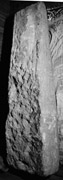
Object type: Part of shaft
Measurements: H. 150 cm (59 in); W. max. 45 cm (17.7 in); D. max. 31.5 cm (12.4 in)
Stone type: Greyish orange pink (5YR 7/2), poorly sorted, clast-supported, pebbly, feldspathic sandstone. The sub-angular to sub-rounded clasts range from 0.4 to 1.0 mm; scattered sub-rounded pebbles up 10mm occur. Roaches Grit?, Marsden Formation, Millstone Grit Group, Carboniferous (C.R.B.)
Plate numbers in printed volume: Ills. 566–8
Corpus volume reference: Vol 13 p. 297
(There may be more views or larger images available for this item. Click on the thumbnail image to view.)
A and C (broad): Dressed-off; no decoration survives.
B (narrow): The surviving decoration appears to comprise a series of almost square motifs which may have been a form of line pattern or, more probably, stylised plant scrolls with leaf motifs in their centres. The patterns have an outer strand, or are contained within a thin moulding, beyond which is a very badly damaged edge moulding.
D (narrow): Decoration survives on only 20% of the stone, on the left, the rest being dressed-off. It appears to be part of an irregular interlace, or possibly a badly executed line pattern, although it is too fragmentary to be certain.
The shaft is too badly damaged to identify the details of its decoration with any certainty. The remains of the pattern on B may resemble the stylised plant-scroll design on Stoke-on-Trent 1C (Ill. 605) where a series of plant motifs are arranged so that they give a sense of a series of square motifs, although equally the design may present a complex version of a linear key pattern like those at Alstonefield (7) and elsewhere at Leek (4) (Ills. 496, 576, 578). However, the fragmentary nature of the decoration makes this uncertain. The remains of interlace or plant scroll on D, are too fragmentary to be diagnostic. Nevertheless, the designs preserve sufficient detail to place them in an Anglo-Scandinavian, tenth-century context, and the monumental dimensions of this piece provide impressive evidence of the presence of at least two large-scale square-shafted crosses at Leek in this period, testifying to the status of the site at the time.
