Select a site alphabetically from the choices shown in the box below. Alternatively, browse sculptural examples using the Forward/Back buttons.
Chapters for this volume, along with copies of original in-text images, are available here.


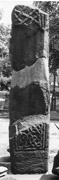
Object type: Shaft with inscription
Measurements: H. 186 cm (73.2 in); W. 44 > 40 cm (17.3 > 15.7 in); D. 31 > 27 cm (12.2 > 10.6 in)
Stone type: Pale red (10R 6/2), poorly sorted, clast supported quartz sandstone. The clasts, varying from sub-angular to sub-rounded, vary from 0.2 to 1.0 mm, but most are in the range 0.4-0.7 mm. The colour is suggestive of the Helsby Sandstone Formation, Sherwood Sandstone Group, Triassic, rather than the Millstone Grit Group (C.R.B.)
Plate numbers in printed volume: Ills. 561–5
Corpus volume reference: Vol 13 p. 295-297
(There may be more views or larger images available for this item. Click on the thumbnail image to view.)
The lowermost portion of each face is plain, apparently intended for insertion into a base.
A (broad): This face is badly damaged with the decoration surviving only at the top and bottom. Above the plain section at the bottom is the lower part of a panel of interlace which takes the form of two surviving registers of complete pattern F (Cramp 1991, fig. 14) with the loops turned inward, that terminate at the bottom in V-bends, the strands then following the inner frame of the panel, a thin inner moulding, with damaged (probably flat band) outer edge mouldings. During restoration a section was inserted above this portion of the shaft, above which is the upper piece. At the top, this is decorated with a short, incomplete length of indeterminate interlace or plait-work which appears asymmetrical. There is a thin inner moulding to the right and a short section of flat-band edge moulding; both are broken on the left-hand side.
B (narrow): This face is near-complete except for a small portion which has been broken away where a modern piece of stone has been let in. There are flat-band edge mouldings on each side, although a large part of that on the left has broken away. Above the plain section at the bottom is a panel of half-pattern D interlace with outside strands (Cramp 1991, fig. 22) that appears to be formed from three strands, although damage makes this uncertain. The loops are formed from V-bends, with long glides between each register, and an inverted Stafford Knot terminal at the bottom (simple pattern E: ibid., fig. 23). This panel of interlace extends more than halfway up the face and is contained by a thin inner moulding. Above is a further panel containing simple pattern F interlace (ibid., fig. 23) formed from two strands, contained by a thin inner moulding. The pattern is incomplete where the stone is broken at the top.
C (broad): At least half of this face has been dressed off on the right-hand side. Above the plain section is a panel of irregular complex interlace comprising turned loops and V-bends but as the pattern is incomplete on the right its full form can no longer be accurately discerned. Nevertheless, within it are several Stafford Knots which may have been mirrored on the right. The panel is contained on the left by a thin inner moulding and flat-band edge mouldings. Above, is a further panel, separated from the lower by a horizontal cable moulding. This contains the extreme left-hand side of an interlace pattern which is too fragmentary to identify its form. The top is broken away.
D (narrow): Almost all of this face is broken away, except for a small section at the bottom above the plain area. This contains an Anglo-Saxon runic inscription.
Inscription The inscription is cut in two vertical lines within an incised rectangular panel on the north face (Ills. 561, 565). The inscription is incomplete: the panel clearly continued beyond the broken edge of the stone fragment, while the surface of the upper part of the right-hand side of the stone is damaged, leaving only a few characters below. The lower end of the panel, however, is evidently complete.
The right-hand side of the text, after the damage, is relatively clear to read. The runes run down to the end of the panel, with their bases towards the middle of the stone. They are just under 10 cm high, and can be transliterated:
The first character is incomplete, its left-hand side lost in the surface damage. What remains appears to be the bow of full-height rune, ‘u’ or less likely ‘r’. ‘i’ is then clear, followed by a three-stroke ‘s’, rather angled and asymmetrical. The ‘a’ which finishes the sequence, immediately before the framing line, is distinct and diagnostic of the Anglo-Saxon, rather than Scandinavian, runic alphabet.
The left-hand side of the text is worn and much less clear than the right. It is also more compressed: the runes are just under 7 cm (2.8 in) high. Traces of some nine upright staves remain, representing perhaps eight or nine runes. None of these can be identified with certainty, though the indications are just about enough to confirm that this part of the text runs upwards from the bottom of the panel, with the bases of the runes also towards the middle of the stone, and thus upside-down with respect to the other line. The first discernible character has a bow to the right of the stave and may well be ‘þ’, less probably ‘r’ or ‘u’. The next might be ‘æ’, though the arms are faint: Elliott (1964, 214) read ‘b’. Alternatively, if the lower arm is illusory, it is possible that the upper is connected to the following stave, turning the whole complex into ‘e’. If there is no connection here, the second stave is probably an ‘i’ since there is no sign of incision to its right: this is what Elliott read. There are marks, but rather indistinct ones, to right of the next stave: they seem to me to suggest ‘o’, though Elliott again saw ‘b’. The next rune, in some lights, looks clearly like ‘r’, though Elliott read ‘æ’. There are then three or four more staves before the broken edge of the stone. The first could again be ‘i’, though it is very worn at the top where something may well be lost. In some lights the last complex looks like a pair of staves joined by cross-arms from top to bottom, producing ‘d’.
It is unfortunate that so much of the shaft has been damaged and broken as it would have provided a good example of the sculptural carving in the region. From what does remain it is clear that the motifs bear similarities with those found on the shaft at Hope, especially with the use of accentuated V-bends, although there are no direct parallels. Perhaps its most unique feature is the runic inscription which is the only one to have survived from Staffordshire, and apart from that from Bakewell (35, p. 142), one of only two extant from the region.
Inscription It is hardly possible to offer an interpretation of the inscription since the text is so fragmentary and the reading so uncertain. The only clear sequence, ‘i s a’, is not helpful–it does not fit any attested epigraphic formula, and the rune preceding ‘i’ cannot be ‘þ’, precluding a reading with the demonstrative þis, ‘this’. Nor does any convincing sequence emerge from the various identifications posited for the left-hand side. Elliott’s suggestion that the text continued from the right-hand line to the left is not unreasonable given the layout, but his proposal of an Old English word ending isaþ is challenging. aþ would be a verbal ending, and while there is a recurrent parallel in forms of gebiddaþ, ‘pray’ (plural imperative), there are no other instances of the ending in Anglo-Saxon inscriptions, and no other likely possibilities present themselves.
One unusual feature of the Leek inscription is its vertical arrangement. Anglo-Saxon runic texts are often set in rectangular panels, but the lines run horizontally. Vertically set Anglo-Saxon runes are rare: exceptions are Whithorn I (Page 1999, 144), where a single line of runes runs down the narrow side of a cross-slab, and Crowle (Everson and Stocker 1999, 147-52), where the runes run down a curving ribbon. It is interesting that Crowle is certainly Scandinavian-influenced in its design, while Whithorn may be since there are numerous parallels for inscriptions along the edge of cross-slabs amongst the Norse rune-stones of the nearby Isle of Man. Indeed it is to Scandinavia, and especially Denmark, that one must look for the closest runic parallels to the layout of the Leek inscription: two or more vertically arranged lines of text between incised framing-lines, sometimes closed off as a panel, is a common arrangement on Danish stones between about the seventh and tenth centuries (see, e.g., the numerous illustrations in Moltke 1985, 148-201). The association should not be pressed: the overall appearance of the Leek stone is very unlike that of the Danish rune-stones, and there are no textual or stylistic details to bolster a suggestion of Scandinavian influence. On the other hand, the parallels are worth mentioning since the only other Anglo-Saxon runic inscription from this part of England appears to bear a Scandinavian personal name (Bakewell 35, p. 142, Ills. 96-7).
Beyond this very uncertain hint of Scandinavian influence, there is little to suggest a date. Most Anglo-Saxon rune-stones seem to belong between the eighth and tenth centuries. Elliott (1964, 214) suggested a very precise ‘first quarter of the 9th century’ for the Leek stone, partly on the basis of the absence of Scandinavian features (he mentioned, but did not develop, the parallels for the layout of the inscription). There are no clear epigraphic grounds to support such a specific dating.
