Select a site alphabetically from the choices shown in the box below. Alternatively, browse sculptural examples using the Forward/Back buttons.
Chapters for this volume, along with copies of original in-text images, are available here.


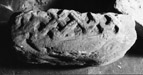
Object type: Part of shaft or base?
Measurements: H. 15.5 cm (6.2 in); W. 52 cm (20.5 in); D. 43 cm (17 in)
Stone type: Yellowish grey (5Y 7/2), well sorted, fine-grained, quartz sandstone. The sub-angular to sub-rounded grains range from 0.1 to 0.2 mm across. Helsby Sandstone Formation, Sherwood Sandstone Group, Triassic (C.R.B.)
Plate numbers in printed volume: Ills. 224–5
Corpus volume reference: Vol 13 p. 190-191
(There may be more views or larger images available for this item. Click on the thumbnail image to view.)
A (broad): Worn flat
B (narrow): The carving consists of the remains of a vertical panel of wide flat bands of interlace with a median incision. The worn condition of the stone on the right means it is not possible to determine how the panel was bounded.
C (broad): Broken
D (narrow): Decorated with the remains of a foliate pattern with wide stems marked with a median incision. In the portion remaining two stems seem to emerge from a nodal point half-way along the length of the stone to sweep round in a wide circular motion, with fleshy tendrils terminating in curls and large pendant leaves emerging from it.
When Routh (1937a, 31-2; 1937b, 35) discussed the stone, he drew attention to its dimensions, suggesting it represented the half portion a cross-shaft cut down the middle (C). The carving preserved on what are now the two narrow faces (B and D), thus comprise half the original decorative scheme, suggesting that they would originally have been 84 cm (34 in) wide, and indicating the presence of a monument of massive proportions. Another explanation of the original monument, however, may be that it formed part of a base cut down to below the socket made to receive a shaft, thus cutting away approximately half the designs on its sides. Whichever was the case, the stone indicates the presence of a carved stone monument of considerably large dimensions within the vicinity of Ingleby and Repton.
Considering the potential nature of this monument further, Routh also discussed the fragmentary foliate pattern on D, noting the long sinuous leaves and sprouting lobes which he regarded as characteristic of Ringerike-style ornament of the early eleventh century, which Brøndsted (1924, 293) claimed derived from the acanthus foliage of the so-called Winchester school of decoration. To support his argument Routh drew parallels with stones at Astbury, Cheshire, and Temple Rothley, Leicestershire (Routh 1937a, 32; 1937b, 35; see Astbury 3, Bailey 2010, 48, ills. 16–18). With these associations, he thought it probable that the stone represented part of the same monument as Ingleby 1. However, the proportions and taper of Ingleby 1 mean it is unlikely that the stones were related in this way, and the stone types are also different. If, however, Ingleby 2 was part of a cross-base, it may be that it formed part of the base into which Ingleby 1 was set. Against this is the fact that the foliate decoration on Ingleby 1 and 2 is very different. Nevertheless, the display of different stylistic details on closely related carved stone monuments is not unknown in an Anglo-Saxon context. As noted by Routh, the capitals of the chancel arch at Bibury, Gloucestershire (Bibury 8 and 9), both dated to the first half of the eleventh century, are notably dissimilar from each other (Bryant 2012, 140–1, ills. 43-4).
As already noted, however, Routh was concerned to date Ingleby 1 to c. 1000 as he found it difficult to accept that a coherently carved stone could date from a period contemporary with Scandinavian activity in the region. Contrary to his opinion it seems that Ingleby 1 can be dated to the late ninth or early tenth century (see above). If Ingleby 2 represents a piece of this monument, contemporary with it, even as its base, it would imply that it would have to be dated a century earlier than would be indicated by its foliate decoration. This is unlikely given the generally accepted view that Ringerike-style foliate ornament, rare in England, is associated with tenth- and eleventh-century phases of activity. Routh also posited a comparison with the stone from Overchurch, Cheshire (Overchurch 1, Bailey 2010, 91–4, ills. 222–9), possibly because of the plait-work decoration on B, although this is unconvincing, and Overchurch 1 has been recently dated to the early ninth century on the grounds of its inscription. In fact, the well-cut plait of double-beaded cords crossing at right angles, with the cords turning sharply at the side, and the small portion of the original flat moulding preserved on one side, suggest that, if the stone can be identified as part of a cross-base, and held the shaft represented by Ingleby 1 (which of course cannot be proved), it could equally represent a later (tenth- or early eleventh-century) phase of activity, which saw the shaft re-presented in an elaborate base. Overall, however, given the paucity of such elaborate carved stone bases in Anglo-Saxon England–not discounting those preserved at Rastrick, west Yorkshire (Coatsworth 2008, 229–30) and Gulval, Cornwall (Preston-Jones and Okasha 2014, 147–52)–it seems that the fragment is more likely to represent the remains of a second (cross) shaft from Ingleby, suggesting the site was of some significance in the period following the initial military activities of the Scandinavians in the area.
