Select a site alphabetically from the choices shown in the box below. Alternatively, browse sculptural examples using the Forward/Back buttons.
Chapters for this volume, along with copies of original in-text images, are available here.


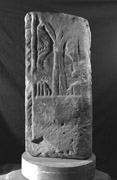
Object type: Part of shaft
Measurements: H. 76 cm (30 in); W. 37 > 32 cm (14.5 > 12.5 in); D. 26 > 20 cm (10.25 > 7.9 in)
Stone type: Pale yellowish brown (10YR 6/2), moderately sorted, clast-supported quartz sandstone. The sub-angular to sub-rounded grains range from 0.2 to 0.5 mm across, but are dominantly in the range 0.3 to 0.4 mm across. Quartz predominates, but there are a few scattered pink feldspars. Helsby Sandstone Formation, Sherwood Sandstone Group, Triassic (C.R.B.)
Plate numbers in printed volume: Ills. 220–3
Corpus volume reference: Vol 13 p. 187-190
(There may be more views or larger images available for this item. Click on the thumbnail image to view.)
Where the carving survives, the upper part of the stone is bounded by cable angle mouldings inset by narrow plain mouldings contiguous with an area of plain dressed stone that fills the lower part of the shaft.
A (broad): The panel framed by the mouldings contains the remains of a centrally placed tree-like plant. This has a wide tapering ‘trunk,’ bisected by a vertical incision, which terminates in a triple-incised binding from which emerge three stems: one continues straight up the shaft; the others branch out on either side. The central and right-hand branch are lost in the damage to the upper part of the stone, but that on the left continues up to meet the plain moulding near the upper edge. Two-thirds of the way along the length of this branch hangs a large fleshy leaf that falls in a wide sweeping S-shape to terminate in a small curl; it is mirrored by the remains of a similar leaf on the other side of the trunk. Below these, and flanking the tree, is a pair of features composed, on the left, as a series of three inverted ‘U’s that diminish in size towards the central trunk, and on the right as a more amorphous undulating shape that likewise reduces in size next to the tree.
B (narrow): The decoration consists of a foliate motif, not dissimilar to that on A. A short thick stem emerges from a series of four horizontal mouldings and terminates in a triple-incised binding from which two thin stems emerge at angles. That on the right is almost completely lost in the damage to the upper part of the stone, while a long thin leaf with a centrally-incised median line hangs from that on the left, falling in towards the top of the trunk; the tip of a similar leaf survives on the right. On the left, this plant is flanked by the remains of a feature forming a wide sweeping S-shape. Unlike the ‘leaf’ on A, however, this does not terminate in a small curl, but merges with a worn, block-like element set on the uppermost horizontal moulding.
C (broad): Bisecting, and running the full length of the stone, is a plain roll moulding. Above the area of plain dressed stone, on the left of this central moulding, are two lengths of cable moulding; on the right is a narrow panel filled with a ‘herringbone’ pattern.
D (narrow): The decoration consists of an elaborately dressed profile figure facing right. The nose is damaged, but the mouth and eyes are clearly defined, and the pupil marked by a deeply drilled hole. He wears a plain cap, which covers his ears and curls up at the edges, and a heavily pleated tunic which is caught up at the front and tucked into the wide belt round his waist, from which it hangs in a sweeping U-shaped fold; the legs are naked below the knees and he does not seem to wear shoes. A bulky bag hanging below the waist is suspended round the neck. The right arm crosses the body to grasp the end of a short staff that passes in front of a long thin stem that grows vertically up the right-hand edge of the panel. The upper end of the staff terminates in a curved feature that is hooked round this stem, causing it to distort slightly. A small horizontal block extends from near the top of the staff, across the chest of the figure; it is unclear whether this represents (the illogically placed) right hand of the figure, or (more likely) a ‘handle’ attached to the staff. Hanging from the upper edge of the stone, and passing behind the curved terminal of the staff, is a second stem that widens out into an oval feature with a small square terminal suspended between the staff and the vertical stem. A long, curled frond extends from the upper part of this stem, at the point of the upper break in the stone, to hang over the figure’s head.
The stone has elicited little discussion since Routh’s initial assessment of its decoration in terms of the style of the foliate ornament on A and B, and the figural style of the carving on D. Routh himself drew parallels with eleventh-century art (Routh 1937a, 30–1; 1937b, 33-4), although in each case he noted that the late Anglo-Saxon examples bore comparison with earlier art. Thus, the foliate decoration of A and B, while being ‘common in the eleventh and twelfth centuries’, was ‘founded on the Carolingian acanthus’ of ninth-century date. Likewise, the attenuated figural style of D was deemed ‘reminiscent’ of the Christ in Limbo at Bristol (Cramp 2006a, 145–6), thought to be ‘founded on early ivories’. In most cases Routh’s examples were dependent on recent publications of museum collections, but it is also clear that the ‘free and lifelike rendering’ of the figure on D caused him consternation within an Anglo-Saxon context; this inspired him to conclude that it was ‘inconceivable’ that it was carved by ‘a Dane or Northman’ (Routh 1937a, 33; 1937b, 36). He thus left open the possibility that the piece could be dated to the twelfth century, even if ‘free-standing crosses are rare after the pre-Conquest period’ (Routh 1937a, 31; 1937b, 34; see Hawkes 2010).
If the foliate and figural style of Ingleby 1 are reconsidered, particularly in the light of subsequent studies into the extensive influence of late antique styles on Anglo-Saxon carved decoration, it is clear that, although much of Routh’s argument concerning the impact of such art is not misplaced, the stone can also be set in the context of earlier (pre-Conquest) art. Thus, the fleshy leaf of A and B, which indeed predominates in ninth-century Carolingian art, is also found in early tenth-century Anglo-Saxon work. In the Athelstan Psalter (London, BL Cotton MS Galba A. XVIII), it sprouts from the border of the Maiestas miniature (fol. 21r), the leaves falling in a manner analogous to that featured at Ingleby (Ohlgren 1992, pl. 1.14); it also forms the terminal of a branch held by Virgo in the accompanying calendar (fol. 11r; Ohlgren 1992, pl. 1.9). This is a manuscript that, produced in Gaul in the ninth century, was supplemented in Anglo-Saxon England in the first quarter of the tenth century with the addition of the illustrated calendar and four full-page miniatures (Temple 1976, 36–7; Keynes 1985; McLachlan 1985; Dumville 1987). Among these additions, two miniatures of Christ (fols. 2v and 21r) are thought to have derived from Insular, possibly monumental, art (Deshman 1974, 176–83), while the other two (depicting the Nativity and Ascension) are thought to have been produced under the direct influence of earlier art from the Eastern Mediterranean (Deshman 1974, 183–92). Here it is worth noting that fleshy acanthus-style leaves also feature in this earlier art (Harrison 1989, pls. 124, 126, 129). The art of the Athelstan Psalter thus demonstrates that motifs which appear to correspond to Carolingian developments could be produced in an Anglo-Saxon context both under the influence of that art, as well as independently under the influence of the earlier Mediterranean art that inspired so many of the Carolingian innovations.
With this in mind, the elements flanking the tree on B are perhaps best regarded in the light of forms that feature in Anglo-Saxon carvings produced under the influence of early Christian art where, from the fifth century onwards they represent the ground: as rocks or a hilly landscape (e.g. Schiller 1971a, 149; 1972, figs. 5, 11). They are arranged in a stylised block from which a plant-scroll emerges, for instance, on Codford St Peter 1, Wiltshire, which has been dated to the late eighth or early ninth century (Cramp 2006a, 211, ills. 427–8: see Ill. 648). The clear inverted U-shapes flanking the tree on A do not appear to feature widely in either Anglo-Saxon or Carolingian art, but they do replicate the standard method of depicting springs or fountains of water in late antique and early Christian art: the motif is preserved on a fifth-century sarcophagus in the mausoleum of Galla Placidia, as well as the early sixth-century mosaics of San Vitale, both in Ravenna (Malafarnia 2006, fig. 66; Bustacchini 1984, 25). Thus, under the influence of early Christian art, the tree on B is probably best understood as growing from a rocky mound, while that on A was shown flanked by springs of water.
Likewise, the attenuated figural style of D was a distinctive feature of eastern-influenced art in seventh-century Rome and was most famously reproduced in Anglo-Saxon England in the early eighth-century Codex Amiatinus (Florence, Biblioteca Medicea Laurenziana, MS Amiatinus 1). The way the Ingleby figure stands in a relaxed, slightly three-quarter turned pose, the way his clothing falls in naturalistic folds around his body and is swept up to be tucked into his belt at the front, and the way the bulbous shape of the satchel indicates its contents, are all features indicative of dependence on a good quality model of this type. The distinctive shape of the cloth hat that rises at the front and falls to the base of the neck in a curl further indicates such a source, this being the standard form of the ‘Phrygian cap’ featured in Roman, late antique and early Christian art, as does the oval element harvested by the figure which recalls botanically convincing fruit that would not be out of place within late antique and early Christian pastoral contexts.
The implement held by the Ingleby figure—a long-shafted tool with a curved blade and short projection just below—can also be understood as having been based on an early pictorial source (see Hawkes 2010). While it could be interpreted as depicting a long-handled billhook (falx arboraria) used for pruning foliage, most of those preserved archaeologically in Britain do not feature the projection at the base of the blade; this is a feature of the tool preserved in Italian contexts where the projection is squared (Rees 1979, ii, fig. 233c; cf White 1967, 86, fig. 63). A similar tool type, falx vinitoria (vine-dresser’s knife), also features the squared projection (ecuris), but these too seem to be absent from Britain in the Roman and early medieval periods; they are, however, present in large numbers in Italy and northern Europe (White 1967, 93–6), and they are depicted in the art of late antiquity (e.g. fourth-century copy of Virgil, Vatican MS Lat. 3225: Stevenson 1983). The billhook also features in late Anglo-Saxon manuscript art where it can be considered either as representing a contemporary object, or as reproducing a late antique prototype (Carver 1986), but in none of these instances does it resemble the tool featured on Ingleby 1D.
This means that it probably represents an object featured in an early pictorial source as opposed to an object contemporary with its production, while stylistically, the type of figure depicted, the plant motif, the acanthus leaf-type and the representation of a rocky ground, all point to that source being of late antique/early Christian origin. Beyond this, stylistically, there is little in the carving that indicates a date of production, although the coincidence of the acanthus-type leaf with the apparent direct influence of a very early figural model would not be incompatible with a date in the later ninth or early tenth century.
Iconographically, the significance of the carving is difficult to assess given the way the figural decoration occurs on only one of the narrow faces (D), while the foliate motif is found on the other narrow face (B) and one of the broad faces (A). The shaft of Codford St Peter 1, by contrast, depicts plants growing from a rocky ground on both the narrow faces while the figure grasping a stylised plant features on a broad face (Cramp 2006a, ills. 425-8: see Ill. 648); it is an arrangement that probably prioritises the figural. By comparison the organisation of the decoration of Ingleby 1 seems to subordinate the figural to the foliate (and the ‘herringbone’ pattern). The extent to which the Ingleby figure can be regarded as an iconographic signifier is thus debatable.
Furthermore, the incomplete nature of the stone means it is uncertain whether he was originally part of a scheme that extended up the length of the shaft, or was presented as a single figure much like that at Codford St Peter where the plant grasped by the figure continues only part-way up the shaft, the entire scheme being contained within an architectural frame (Cramp 2006a, ill. 425). In the most recent discussion of the Codford scheme, Cramp (2006a, 209–11) suggests that the figure might ‘best be seen as engaged in picking fruit’, and indeed, the object held in his left hand bears a striking resemblance to the stylised round fruit growing on the short thin stems of the plant held aloft by the figure in his right hand. Despite the differences of setting, therefore, and the comparatively animated rendering of the Codford figure, the possibility of a shared (fruit picking) activity and the common association of the repeated scheme featuring a plant growing from rocky ground implies that the Ingleby figure might usefully be considered as a single figure engaged in harvesting fruit–as opposed to having been part of an extended scheme of figures within a foliate setting.
This is a rare subject in an Anglo-Saxon context and, apart from Codford St Peter, occurs only in the later Anglo-Saxon calendars. A strap-end from Cranbourne Chase (Dorset), which stylistically seems to emerge from a later ninth-century context, does depict a knife-wielding figure in a short tunic striking an animated pose comparable with that at Codford (Cramp 2006a, ill. 539), but he is entwined in the plant which bears no fruit; identifying him as harvesting fruit is thus unconvincing. Indeed, Webster (2003a, 88–9) has argued that he either symbolises the sense of Taste or refers to Christ as the Tree of Life.
Viewed against this small corpus of images it is perhaps best to consider the Ingleby figure in association with the repeated scheme of the plants on 1A and 1B. In early Christian and medieval art, individual tree-like plants growing from an identifiable ground tend to illustrate the Tree of Life growing in Paradise which, in Revelation 22: 2 is ambiguously described as being planted on either side of the river of the water of life (O’Reilly 1988, 344–8; 1992, 170–80). It is, in effect, given a two-fold aspect while the river is described as a single entity: ‘on both sides of the river, was the tree of life, bearing twelve fruits, yielding its fruits every month, and the leaves of the tree were for the healing of the nations.’ If the trees on A and B can be understood as growing within springs of water (A) and emerging from a rocky ground (B), it can be assumed that they were intended to convey notions commonly associated with the paradisal Tree of Life. Furthermore, in early medieval biblical exegesis the theme of harvesting generally involves discussion of the Tree of Life, the Rivers of Paradise, and the Judgement of the Second Coming, with life eternal awaiting those who confess their sins, confession being the fruit yielded by the earth to be harvested at the appropriate time (see further Hawkes 2010).
The scheme of Ingleby 1, set on a cross-shaft, could thus be understood to signify various inter-related themes: the cross of the crucifixion, the universal nature of the salvation afforded by that event, the sacraments and eternal life (Greenhill 1954, 331–7; O’Reilly 1988, 34–5; 1992, 170–8). These are symbolic associations that were represented visually by non-figural schemes from as early as the sixth century in contexts involving two identical stylised tree-like plants set on either side of a cross, and in close association with a fruit-bearing tree (e.g. eighth-century relief, Cividale: Hawkes 2002a, fig. 2.32; O’Reilly 1992, 175–8 for further examples of sixth- to ninth-century date). The arrangement of the motifs at Ingleby presents an analogous scheme in its overall programme, with stylised trees set on two sides of a cross-shaft, and a fruit-bearing tree figured on a third: the harvesting figure is effectively set within the context of the two trees.
Overall therefore, despite assumed similarities with eleventh-century art, the details of Ingleby 1 can be dated to the later ninth or tenth centuries and understood to present a complex set of references to Resurrection and eternal life in a paradisal setting. It thus offers a representation of these themes unique in Anglo-Saxon art and a valuable insight to the varied figural art produced in the region in sculptural contexts.
