Select a site alphabetically from the choices shown in the box below. Alternatively, browse sculptural examples using the Forward/Back buttons.
Chapters for this volume, along with copies of original in-text images, are available here.


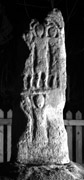
Object type: Shaft
Measurements:
Shaft: H. 160 cm (63 in); W. 57 > 47 cm (22.5 > 18.5 in); D. 49 > 38 cm (19.25 > 15 in)
Base: H. 59 cm (23.25 in); W. 105 > 104 cm (41.3 > 41 in); D. 96 > 85 cm (37.75 > 33.5 in)
Stone type: Well-sorted, pale red (10R 6/3) to pale reddish brown (10R 6/4) marginally feldspathic, dominantly fine-grained sandstone, but with some grains up to 0.3 mm. Quartz predominates, with feldspar forming little more than 1%. Most grains are angular though the occasional more rounded grain occurs. Namurian sandstone consistent with a delta-top to turbidite transitional form of the Ashover Grit Member, Marsden Formation, Millstone Grit Group, Carboniferous (R.T.)
Plate numbers in printed volume: Ills. 557–60
Corpus volume reference: Vol 13 p. 293-294
(There may be more views or larger images available for this item. Click on the thumbnail image to view.)
The lowermost 30 cm (11.75 in) of the stone appear to have been left plain. Where the decoration survives, it seems to have been arranged in two panels set one above the other on each face.
A (broad): The upper panel on this face is contained by a double arched roll moulding at the top (extant on the right), and a plain horizontal moulding running across the middle of the shaft, below which is the second panel that extends to the undecorated band at the base. (i) In the upper panel are the worn remains of three full-length standing forward-facing figures wearing short robes, their legs, naked from above the knees, being slightly flexed and turned to the right. The body of the figure on the left is largely lost in the damage sustained to the stone at that point. Surrounding all three heads, which are rounded oval shapes, is a continuous series of arches resting on the shoulders of the central figure, and the outer shoulders of the two flanking figures. The shoulders of all three seem to be conjoined. A pellet lies on either side of the arch surrounding the head of the central, slightly taller, figure. There is some indication that the robe of the left-hand figure may have been filled with interlace ornament, and although the surface of the robes of the central and left-hand figure bears the signs of worn indentations, it is unclear whether they were plain or also decorated with interlace. (ii) The panel below bears the remains of a central, full-length figure whose arms are upraised on either side of its rounded oval head, in which the indentation of the mouth is still visible. The area on the upper right of the panel is worn away, but a plain flat area of carving remains on the lower right. On the left, much of the carving is also worn away, but adjacent to the upraised arm a plant stem curves over in a sweeping S-shape, enclosing a large leaf or blossom. The area of carving below the damage retains signs of indentations, but their original nature is unclear.
B (narrow): The upper panel is filled with a thin-strand complex interlace pattern, too worn to identify, contained in an arched frame formed by a thin roll moulding. Any decoration in the lower part of the shaft has been lost in the considerable wear and damage sustained to this part of the stone.
C (broad): Between the break at the top of the stone, and the arched moulding forming the upper panel is a row of pellets, clearly visible on the right. (i) The panel itself is filled with the worn remains of three standing figures whose full-length robes form discrete panels of interlace. The central and left-hand figures filling the upper portion of the arched panel, are taller than that on the right. The legs of all three emerge from their robes, to stand on the arched moulding defining the lower frame of the panel. The arms of the central figure are upraised on either side of the head, and may well have arched over to enclose the head of the figure on the right. It is unclear whether the figure on the left has one arm upraised, but that on the right does not seem to have had arms; a pellet fills the space between the shoulder of this figure and that in the centre. (ii) Below the lower arched moulding is a row of large pellets contained by a second arched moulding forming the lower panel which is contained by the undecorated band at the base. The decoration of this panel is very eroded, but seems to have been filled with a circular interlace pattern (closed circuit pattern C: Cramp 1991, fig. 24), with four twisted loops linking three concentric rings.
D (narrow): The damaged and eroded condition of this face means it is impossible to decipher the carved decoration with any certainty. It appears, however, that at least one full-length figure stood on the upper left of the shaft, turned in profile: one leg is visible, the foot turned towards the central vertical moulding that extends two-thirds up the length of the shaft. It also seems that the right arm of this figure was bent sharply at the elbow so that the hand was upraised by the head. At the top of the panel, below the break, it appears that a carved strand extends from above the figure, behind the upper portion of the central divide, and down on the left. The damage to the shaft on the right means it is not possible to determine what was situated on this side of the central divide, but below was an area of interlace, with a large triquetra surviving above the plain horizontal band at the base of the shaft.
In many respects, as has been frequently noted, the decoration of this shaft echoes that of Checkley 1 and 2, with the layout of the carving in panels forming complex and well-formed interlace panels (which on B may have been set out in such a way as to contain central cross-shapes), interspersed with pellets and panels of figures arranged in groups of three, whose arms are upraised and who are characterised by rounded ovoid heads and garments of interlace. As noted by Plunkett (1984, 274), the shafts seem to emerge from a shared campaign of production, with access to common models that are, nevertheless adapted in slightly different ways at the two sites. For instance, while the interlaced figures are confined to Checkley 1 (Ill. 524) and those with plain garments are found only on Checkley 2 (Ills. 526-7), the two types are combined here. Furthermore, the remains of the shafts at Checkley show no signs of figures flanked by foliate motifs (as occurs on Ilam Estate 1A), and the dimensions of this shaft are of considerably greater monumental proportions.
Beyond such stylistic and technological comparisons, however, there is little that can be recovered of the iconography of this shaft. The repeated groups of three figures, some of whom seem to be nimbed, and others of whom seem to be in the orans pose, raises the same questions as apply to those at Checkley. However, the profile figure facing the central vertical divide on D does indicate that another iconographic scheme may lie behind the panel. The way the figure faces, but does not seem to grasp the central moulding, and has one hand raised towards its head, as well as the manner in which thin strands of carving seem to pass from the top of the central divide and over the head of this figure, might imply that an image of Adam and Eve (such as that on Eccleshall 2, Ill. 540), may have influenced the scheme. The extreme damage to the stone means this cannot be ascertained, but such an identification would not be at odds with groups of figures that might have carried a significance analogous to that of the Checkley shafts: of salvation available through the Church based on Christ’s sacrifice and passion, a theme that may also have been invoked in the possible arrangement of the interlace patterns to present cross-shapes.
