Select a site alphabetically from the choices shown in the box below. Alternatively, browse sculptural examples using the Forward/Back buttons.
Chapters for this volume, along with copies of original in-text images, are available here.


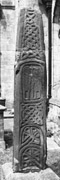
Object type: Part of shaft, in two pieces now joined
Measurements: H. 196 cm (77 in); W. 46 > 25 cm (18 > 10 in); D. 24 > 16 cm (9.5 > 6.25 in)
Stone type: Poorly sorted, clast-supported, medium- to very coarse-grained, light red (5YR 6/6), feldspathic sandstone. The clasts, varying from sub-angular to sub-rounded, vary from 0.3 to 1.5 mm, but most are in the range 0.4–0.9 mm; there are a few granules up to 3 mm across. Kinderscout Grit, Hebden Formation, Millstone Grit Group, Carboniferous (R.T. & C.R.B.).
Plate numbers in printed volume: Ills. 214–18
Corpus volume reference: Vol 13 p. 184-186
(There may be more views or larger images available for this item. Click on the thumbnail image to view.)
The shaft is decorated on all four faces although that on D is partially indistinct. Where they survive, the edges are bounded by flat-band mouldings, and an arched moulding, springing from the arrises on each side, divides the decoration on each face.
A (broad): This face is decorated with interlace and two figural panels. (i) The top of the shaft is decorated with one such panel which, although badly worn, appears to depict a profile figure (turned to the left) wearing a short tunic, and possibly a cloak, standing on a quatrefoil knot with the feet turned to the right. The right arm seems to bend diagonally across the body to grasp (with an enlarged hand) a long, flat vertical moulding that extends down, past the knot, to the arched moulding below and/or a long object over its shoulder. A similar moulding extends down the right-hand side, but terminates above the knot, which may incorporate an animal head with a pierced eye on the right, just below the break in the stone, although the damage sustained at this point means this is very unclear. Because of this it is difficult to ascertain the detail, but it appears that the figure has a double outline round his head, possibly indicating a helmet, and the object over his shoulder could well be a sword. The figure is carved in a highly stylised manner (as with other figures on this stone). In the right-hand corner of the panel is an indistinct small object or design. (ii) Below the arched moulding which separates this panel from the decoration below is the second figural panel, containing two figures in close proximity to each other surrounded by an inner moulding. Again, the details are badly worn but the figures appear to face forwards, wear short tunics, and stand with their feet turned to the right. Traces of pierced eyes, and a possibly drilled mouth, survive. The head of each figure is enclosed by a roll moulding which, in a mirrored arrangement, extends from the shoulder, around the head, to a point above the upper shoulder where it bends to extend diagonally across the body. That on the right extends across the width of the left-hand figure; that on the left terminates over the chest of the right-hand figure in a small rectangular object. (iii) Below is a panel of interlace consisting of three linked closed-circuit knots, each formed of two concentric rings and two parallel diagonal strands, which are linked together by strands of interlace extending from the diagonals of the latter (closed circuit pattern C: Cramp 1991, fig. 24). The lowest pattern is slightly obscured by the base plinth.
B (narrow): The decoration consists of two panels of interlace, separated by an arcade springing from each side arris, as on A. (i) The top is filled with a four-stranded plain plait which diminishes in width corresponding to the taper of the shaft; it terminates on the arcade below in turned loops. (ii) The lower part of the shaft is decorated with two separate interlace patterns. That immediately below the arcade comprises a looped interlace pattern of three strands (simple pattern F: Cramp 1991, fig. 23), which terminates at top and bottom in one strand forming closed loops with the two remaining strands touching the arcade, above, and the lower interlace pattern, below. This takes a different form, comprising an irregular half pattern with returned asymmetrical loops springing from a slightly curving central stem which is much thicker than the strands of the loops, giving it a plant-like appearance. The top of the central thick strand curls around itself, thins and forms the upper asymmetrical loop. It then crosses the central stem to form the lower loop. The pattern appears to repeat itself below, although all but the tip of a lower loop has been truncated or is obscured by the base plinth.
C (broad): This face is decorated by interlace patterns and a panel containing two figures. (i) The top panel comprises a four-strand simple interlace, two strands of which terminate at the bottom to form a closed-circuit pattern. Two emerging strands at the top of this regular part of the interlace change to an irregular pattern which is incomplete but the left-hand strand can be seen to form a loop with the right-hand strand rising vertically and over, to join the loop on the left. Two further strands emerge from the top but the pattern is truncated at this point. (ii) Below is an arcaded panel containing two profile figures with pierced eyes, wearing short tunics. They confront each other and, with enlarged hands grasp a central staff apparently surmounted by a small cross-head. A double outline surrounds the top and back of each head, which runs into the arms which cross the bodies at a sharp angle below the head. The left-hand figure grasps the shaft at a higher level than the figure on the right. (iii) Below is a single closed-circuit interlace knot (closed circuit pattern B: Cramp 1991, fig. 24) consisting of two concentric rings and two parallel diagonal strands which close on the outside in loops. (iv) At the base of the shaft are two foliate motifs consisting of four to five irregularly shaped loops extending from a stem which rises on the right-hand side of the panel with a branch emerging from the bottom. The rising stem continues to loop over the upper motif and down its left-hand side until it bends acutely to provide the stem for the upper motif. The pattern appears to continue below, although this is now obscured by the base plinth.
D (narrow): Despite the damage some of the carving can be discerned. As with the other faces, the decoration is separated by an arcade springing from each arris. (i) At the top is an irregular interlace pattern, similar to an ‘exploded scroll’ (Cramp 1991, fig. 10), composed of a central curving strand thicker than others, giving it an organic or a plant-like appearance. At the bottom the pattern terminates in a strand forming a thin curl with a node extending on the left to end in a pellet or berry; it is this strand that thickens to form the central stem, above which a small part is missing, but which extends to the top of the shaft where it is lost in the break in the stone; it divides into two about half-way up. On the lower right-hand side there is an indistinct strand of interlace with two pellets and a further three pellets a little higher up. On the left is a large pellet with curling strands of further interlace at the top near the upper break in the shaft. (ii) The lower panel consists of an irregular two-strand interlace pattern which is damaged and becomes indistinct towards the bottom. It nevertheless appears to form a series of irregular simple turned patterns which terminate in a closed loop below the arcade. Some of the loops appear elongated as the pattern changes from one looped design to another. The bottom of the panel is indistinct and truncated.
Given the dimensions of the taper of the surviving portion of the shaft, it is likely that it was not originally much taller, and although part of the shaft is missing at the join in the stone, again the taper suggests that little has been lost here. The extent of loss in the plinth stone is unclear but it is unlikely that much has been lost. The distinctly irregular interlaces and closed-circuit patterns are unusual for this part of Derbyshire, but the changing thicknesses of the strands, especially the incorporation of a ‘central stem’ with pellets, nodes and elongated loops are common in the south of the county at, for example, Derby (1) and in Staffordshire, at Leek (1). The figure at the top of A was interpreted by Routh (1937a, 28-9; 1937b, 31) as holding a cross, an identification confirmed by Plunkett’s subsequent rubbing (Plunkett 1984, pl. 44), but the stance of the figure and the shape of the object could equally suggest it is perhaps better interpreted as a sword. Regardless of whether it is a cross or a sword, the possible animal head incorporated into the knot might suggest the figure could be interpreted as Christ-like, overcoming death, in the tradition of Christ triumphant. This hypothesis must, however, remain extremely tenuous given the lack of clarity in the carving. The identity of the paired figures on A and C is also unclear, but they could be interpreted as people formulating an agreement. If the rectangular object held by the figure on the left can be interpreted as a book (Ill. 216), this might imply an ecclesiastical element, while the apparent cross between the figures on C (Ill. 219) suggests a firmer ecclesiastical frame of reference, perhaps signifying the acceptance of Christianity by one of the figures, the other perhaps being his sponsor.
It is tempting to explain these scenes and link them historically, to the acquisition of land in the area recorded in the early tenth century. There are a few examples of estates being ‘bought’ by Anglo-Saxons from Viking settlers (Davies 1982, 803–4), but Hope provides one such example in the north Midlands. A charter of 926, concerning the Hope and Ashford estates in the Peak, records that it was previously ‘purchased’ by King Edward and ealdorman Æthelred of Mercia from its ‘pagan’ owner (... a paganis emerat iubente Eadweardo rege necnon et dux Æþelredo cum ceteris comitibus atque ministris in iuris hereditarii libertatem concedens donabo (Sawyer 1975, charter 397); the transaction must have taken place c. 910, before Viking Mercia formally submitted to the West Saxons (Hart 1975, 103; Sawyer 1975, 31). At this time Hope was located close to the border between Anglo-Saxon Mercia, Northumbria and Viking Mercia in the northern part of the lands of the Pecsaetna, which may have held semi-independent status. It may have been this ambiguous position of the Peak that enabled the transaction to take place before the formal submission in c. 920 by the Mercian and York Vikings (Sidebottom 1999, 11–13). The figural scenes may represent a visual record of this transaction. If this is the case, the uppermost figure on A could be explained as a local landholder, in the guise of a victorious warrior, perhaps, but by no means necessarily, being presented in imitatio Christi (in triumph; see Chapter VI), at the time of erection of the cross.
