Select a site alphabetically from the choices shown in the box below. Alternatively, browse sculptural examples using the Forward/Back buttons.
Chapters for this volume, along with copies of original in-text images, are available here.


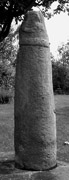
Object type: Round-shaft
Measurements:
H. 134 cm (53 in); W. 23 cm (9 in); D. 16 cm (6.25 in)
Circumference: 118 > 96 cm (47 > 37.75 in)
Stone type: Recorded as 'sandstone' (Hill and Seddon 1998, 147)
Plate numbers in printed volume: Ills. 542–6
Corpus volume reference: Vol 13 p. 287
(There may be more views or larger images available for this item. Click on the thumbnail image to view.)
Round shaft, type g/h (Cramp 1991, fig. 1), from which most of the upper rectangular section has been lost, though the lower parts of the U-shaped panels are still visible. A horizontal moulding encircles the upper part of the cylindrical shaft. Below this are traces of a horizontal spiral scroll on the north and west faces. Shoots emerge from the centre of the spiral and pass downwards under the main stem, with trumpet forms (or possibly a double leaf), springing upwards. There are possible traces of vertical relief ornament on the shaft (Bailey 2010, 154).
The remains comprise a round-shaft monument, typical of those in Derbyshire and Staffordshire, and in Cheshire where they do not seem to have been erected in churchyards. Bailey has suggested that this shaft may originally have formed a boundary-marker. The placement of the decoration has parallels in the region: on Ilam 2 and Bakewell 25, for instance (see Bailey 2010, 154 for further examples).
