Select a site alphabetically from the choices shown in the box below. Alternatively, browse sculptural examples using the Forward/Back buttons.
Chapters for this volume, along with copies of original in-text images, are available here.


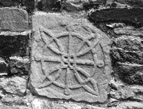
Object type: Part of funerary slab
Measurements: H. 49 cm (19.3 in); W. 47 cm (18.5 in); D. unknown
Stone type: Greyish orange pink (5YR 7/2), poorly sorted, clast-supported quartz sandstone. The dominant quartz clasts vary from sub-angular to rounded,and range from 0.3 to 1 mm across, with a few grains up to 2.5 mm. The dominant grain size ranges from 0.4 to 0.7 mm. Millstone Grit Group, Carboniferous (C.R.B.)
Plate numbers in printed volume: Ill. 475
Corpus volume reference: Vol 13 p. 258
(There may be more views or larger images available for this item. Click on the thumbnail image to view.)
The only visible face of this piece is decorated by a ring-knot pattern comprising a central Maltese cross with closed-circuit ring touching each arm of the cross near the extremity of its arms. There are four diagonal loop designs extending from a central square motif.
Appendix B item (stones wrongly associated with pre-Conquest period)
This piece is perhaps too precisely-cut and geometrical to be Anglo-Saxon and, although such designs can be found in a pre-Conquest context (hence Cox’s identification), it is highly likely to be part of a later medieval tomb slab. Ryder (2016, 71) includes it in his corpus of medieval cross-slabs in Derbyshire and dates it to the second half of the twelfth century, noting that it is rendered in a style similar to the post-Conquest sculptures at Bakewell.
