Select a site alphabetically from the choices shown in the box below. Alternatively, browse sculptural examples using the Forward/Back buttons.
Chapters for this volume, along with copies of original in-text images, are available here.


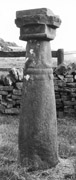
Object type: Round-shaft
Measurements:
H. Overall: 109 cm (43 in); Rectangular section: 35 cm (14 in)
W. 33 > 18 cm (13 > 7 in); D. 34.5 > 16 cm (13.5 > 6.25 in)
Stone type: Poorly sorted, clast-supported, pale reddish brown (10R 5/4), feldspathic sandstone. The clasts, varying from sub-angular to sub-rounded, are dominantly clear quartz with a few pinkish feldspars. Clast size varies from fine-grained (0.2 mm) to very coarse (2 mm). Chatsworth Grit Member?, Marsden Formation, Millstone Grit Group, Carboniferous (C.R.B.)
Plate numbers in printed volume: Ills. 210–13
Corpus volume reference: Vol 13 p. 183-184
(There may be more views or larger images available for this item. Click on the thumbnail image to view.)
A round-shaft with the remains of a rectangular-sectioned upper portion, the top of which is missing. The lower cylindrical section is smooth and undecorated, terminating in a double collar below the rectangular-section. The collar is rounded, smooth and undecorated. The extant decoration is preserved on the upper section.
A: The face has a U-shaped round moulding, the upper part of which is truncated. There is no discernible decoration within this.
B: This face is also decorated with a U-shaped moulding, which contains a modern incised rectangle and the letters ‘H L’ and a date: ‘1720’.
C: The face again has a U-shaped round moulding, the upper part of which is truncated and there is some damage. There is no discernible decoration within the U-shaped moulding.
D: This face is badly worn and damaged but another U-shaped moulding can be discerned. There is no visible decoration within the moulding.
Sometimes referred to as the ‘Shall-Cross’ (Andrew 1905), the monument is one of a number of round-shafted crosses found in many areas of England, with a considerable number of similar dimensions found in this region, most of which–including this piece–are concentrated around the border area between north-western Derbyshire, north-eastern Staffordshire and south-eastern Cheshire (Sidebottom 1994, distribution map 9). The cylindrical shape of this monument may not have been significant to Anglo-Saxon masons, the choice between a round and rectangular shaft being simply pragmatic. As with the other examples, this may have been fashioned from reused Roman milestones, with the upper part carved away to create the tapered appearance (cf. Fig. 35, p. 86). Here, the former Roman road heading northwards from Buxton close to where this monument may have originally stood, is perhaps not coincidental.
