Select a site alphabetically from the choices shown in the box below. Alternatively, browse sculptural examples using the Forward/Back buttons.
Chapters for this volume, along with copies of original in-text images, are available here.


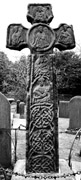
Object type: Part of shaft and cross-head, in two pieces now joined
Measurements:
Shaft: H. 174.5 cm (68.5 in); W. 51 > 39.75 cm (20 > 15.6 in); D. 38 > 29 cm (15 > 11.5 in)
Cross-head: H. 75.5 cm (29.75 in); W. 98 cm (38.5 in) across horizontal cross-arms
End of cross-arms: H. 34 cm (13.5 in); W. 25 cm (9.8 in)
Stone type: Poorly sorted, clast-supported, fine- to coarse-grained, very pale brown (10YR 7/3), feldspathic sandstone. The clasts, varying from sub-angular to sub-rounded, are dominantly clear quartz in the range 0.2 to 0.7 mm, but a significant quantity of feldspar is present. There are a few clasts up to 1.0 mm. Kinderscout Grit?, Hebden Formation, Millstone Grit Group, Carboniferous (R.T. & C.R.B.)
Plate numbers in printed volume: Ills. 200–9; Fig. 4d
Corpus volume reference: Vol 13 p. 179-183
(There may be more views or larger images available for this item. Click on the thumbnail image to view.)
First mentioned by Lyttelton in 1755 in a paper presented to the Society of Antiquaries in 1756. He describes it as being 'in Eyam church-yard', and records that he 'formerly gave an account of it to this learned society' (Lyttelton 1773, 51). Although the minute books of the Society preserve no record of this account, they do note that Lyttelton visited Derbyshire in 1743 when he saw the cross at Bakewell and illustrated it for the Society ((—) 1743). This visit is further noted in Lyttleton's own notebook (London: Society of Antiquaries MS 187H, fols. 11–13), although here, no mention is made of either Bakewell or Eyam because, as he notes at the front of his notebook, it was compiled to record 'chiefly the antient arms I met with in Church Windows which as they are daily perishing may hereafter be of use to those who shall describe the antiquitys of several countys wherein they lye'. This focus, and the neat hand in which the manuscript is written, suggesting a fair copy compiled from a previous set of notes, means it is not unlikely that it was during his visit to Derbyshire in August 1743 that he saw the cross at Eyam.
It is next mentioned in the public record by the Lysons in 1817 as standing in the churchyard in its current condition–with the incomplete cross-head set on the broken top of shaft (Lysons and Lysons 1817, ccxxxv). A year later Rhodes (1818, 57–9) recorded that 'the cross' had been removed to the churchyard from neighbouring hills, describing how 'the finest part of this vestige of antiquity' was left 'in a corner of the church-yard [...] overgrown with docks and thistles'. He further credits the then elderly sexton of the church with recalling that the upper part of the shaft had also, during this period, been broken up 'for domestic purposes', and that the 'top part of the cross' was 'placed [...] on the still dilapidated shaft' only because of the interest of the penal reformer, John Howard, during his visit to Eyam to consult the plague records 'about thirty years ago'–sometime during the 1780s.
While this account has been taken by subsequent authors to indicate that the entire monument (shaft and cross-head) were brought to Eyam from elsewhere (e.g. Hicklin and Wallis 1869, 146–7; Cox 1877a, 195–6),[1] Lyttelton's notes suggest that the remains were in the churchyard in the 1740s, and that the shaft was standing upright when he saw it: a recumbent monument is unlikely to have inspired comparison with the monumental shaft at Penrith–the context in which he saw fit to invoke Eyam 1 in 1755. Thus, Lyttelton's note and a careful reading of Rhodes' account suggest rather, that the current shaft was standing in Eyam church-yard in the 1740s, perhaps where it had always stood; that the upper part of the shaft was subject to damage in the latter part of the eighteenth century; and that the cross-head, lying in the churchyard, was subsequently (re-)placed on the shaft. If this reconstruction was indeed undertaken through the aegis of John Howard at the time he was preparing his Account of the Principal Lazarettos in Europe, with Various Papers Relative to the Plague, which was published in Warrington in 1789, the cross-head might have been united with the shaft at some point between 1785 and 1788 (Morgan 2004).
However, drawings made by Hayman Rooke in May 1780 (Rooke 1780, 2002–98/165) show the monument as it now stands in the churchyard, with the cross-head set on the truncated shaft (Fig. 4d, p. 4). This implies that the tradition associating the monument with John Howard should perhaps not be used to date the reconstruction to the later 1780s. Furthermore, Rooke's notes, made at the same time as his drawings, use the fact that the shaft was standing erect in the churchyard to dispute the 'antiquarian repertory' concerning the peregrinations of the monument, recording that it was only the cross-head that 'lay for a long time against the side of the church' until it was placed on the 'broken shaft' by 'the present rector, Doctor Seward'–this being Thomas Seward, who lived in Eyam until 1748 when he moved his family to Lichfield (Cooper 2004). Seward and Howard were long-standing acquaintances and Howard's observations about the cross-head may well have been made during an earlier visit to the village.
The cross-arms and shaft are framed on all four faces by plain angle roll mouldings. On the cross-head these emerge out of (but are not contiguous with the plain roll moulding that forms a centrally placed circular medallion. On the shaft the angle mouldings are supplemented on A by a thin plain inner roll moulding from which spring curved arches that frame the carved decoration contained in the panels thus formed.
A (broad); Cross-head: The vestigial remains of the lower cross-arm have been dressed back, removing any sign of original carving, but the remaining three arms and central medallion are filled with the figures of forward-facing angels. They have elongated oval-shaped faces with short hair and deeply drilled eyes, and they grasp, with both hands, floriated rods that pass diagonally across their bodies and over their left shoulders to extend into the upper right of the panel. In the case of the angels in the central medallion and right cross-arm, the terminal of the rod is situated over the wing, rather than extending into the roll moulding, as is the case in the upper cross-arm, and that on the left. The wings of all four angels frame their faces, curving sharply over to hang on either side of the torso in a series of parallel ribs. All four angels wear a plain undergarment that has a band around the neckline. Over their shoulders, they wear a heavily pleated over-garment that cascades over their arms in a series of billowing ribbed folds, from which their hands emerge to clasp the rod, and which terminate in a line following the edge of the lower roll moulding framing them.
Shaft: (i) The top of the uppermost panel has been lost in the cut at the top of the shaft, but the spring of the arch remains on each side of the inner moulding. This panel contains the remains of a foreshortened, forward-facing figure. The head is lost above the chin, but it seems to have been veiled: lines of drapery framing the face fall onto the shoulders and are contiguous with the drapery falling in folds over the shoulders and arms. Overlying the torso of this figure is the diminutive body of a child, with an oval-shaped head and short hair. The enlarged right hand of the supporting figure crosses the lower part of the child’s body, holding it just above the feet which emerge from the hemline of a skirt, intruding over the full width of the arched frame below. A sub-rectangular shape lies diagonally across the child’s chest and is traversed by a narrow, slightly curved piece of carving extending from the left shoulder. (ii) The panel below is filled with a forward-facing figure with short hair, deeply drilled eyes, and a face displaying well-modelled cheeks, chin and mouth. He wears a full-length undergarment, with a band across the neckline, that hangs in a sinuous line above his feet; these intrude over the arched frame below. An over-garment hangs over his shoulders in heavy pleats that cross the body and fall over his arms to hang in S-shaped folds on the left side of the body. The right arm is bent across the body to hold a large curved wedge-shape that terminates in a curl under his right elbow and extends over his left shoulder where it widens out. It is supported at the upper end by the left hand that emerges from the folds of the over-garment. (iii) Below this panel, the vertical inner roll mouldings and the slightly arched lower moulding that frame this panel extend to form two complete registers, and most of a third, of a four-strand encircled pattern F interlace (Cramp 1991, xxxvii, fig. 19).
B (narrow); Cross-head: The upper cross-arm is decorated with a simple quatrefoil knot, which is repeated in the soffit of the horizontal arm. The end of this cross-arm is filled with the half-length figure of a forward-facing angel. His face is oval-shaped, has short hair, well drilled eyes and well modelled cheeks and chin. His wings, outlined by thin roll mouldings, rise on each side of his face and fall in a series of parallel ribs on either side of his torso. He wears a plain undergarment and an over-garment that falls from his shoulders in heavy pleats, while a fold of drapery cascades over his right arm, which is bent across his body to grasp a floriate rod that extends over his left shoulder and terminates above his wing in the upper corner of the panel.
Shaft: The shaft is filled with a repeating six-strand turned pattern C interlace (Cramp 1991, xxxiv, fig. 16).
C (broad); Cross-head: The three surviving cross-arms and central medallion are filled with the figures of forward-facing angels. They have elongated oval-shaped faces, deeply drilled eyes and the worn remains of short hair. Those in the cross-arms grasp, with both hands, a trumpet that extends from their mouths to terminate by the angle moulding in an elliptic opening carved in deep relief. The angel in the upper cross-arm holds the trumpet to the left, while those in the lateral cross-arms hold theirs towards the central medallion. The central angel grasps, with both hands, a long staff that extends across the right side of the body, over the shoulder, to terminate in a floriate motif that intrudes into the surrounding frame. The wings of all four angels rise on either side of their faces (where not too worn, surrounded in a thin roll moulding), and fall on either side of their bodies in a series of parallel ribs. They wear garments that fall from their shoulders in heavy pleats, and over their arms in S-shaped folds just above the lower roll moulding framing the panels.
Shaft: The shaft is filled with a fat-stemmed plant scroll arranged to form the remains of five tightly scrolled spirals that branch from the main stem that winds its way in a regular S-pattern the full length of the shaft. The nodes of the stem are marked by four well-defined bands from which a central, short branch emerges to terminate in three bands from which grow two spear-shaped leaves flanking a small curved lobe that fill each alternate interstice of the spirals. The spirals themselves are filled with three spear-shaped bunches of berries, while an additional short branch, terminating in similar clusters of berries, hangs down over the outer curve of the spirals to fill the other alternate interstices between the spirals. The lowermost spiral is more loosely formed, with wider stems, the centre being filled with a single, spear-shaped cluster of berries.
D (narrow); Cross-head: The upper cross-arm is decorated with a simple quatrefoil knot, as is the underside of the horizontal arm. The end of this cross-arm is filled with a half-length forward-facing figure whose hair extends half-way down the side of the face which displays drilled eyes and well modelled cheeks and chin. A crack in the stone bisects the face below the nose. The figure wears an undergarment shown as a series of horizontal folds over the upper part of the torso, and an over-garment that falls from the shoulders in heavy pleats terminating in an undulating line above the lower moulding. The right hand, held over the chest, emerges from folds of drapery that cascade over the right arm, while the left hand, held below the right, emerges from drapery cascading over his left arm. Nothing protrudes over the shoulders, but the vestiges of a rod cross the body diagonally from the left hand to terminate at the edge of the right shoulder.
Shaft: The shaft is filled with a repeating six-strand turned pattern C interlace, like that on B.
The style of the carved figural, foliate and interlace decoration of Eyam 1 have been much discussed, linking it with those at Bakewell and Bradbourne (see Chapter VI, Bakewell 1, Bradbourne 1), yet consideration of the iconographic significance of the figural panels has been comparatively neglected. Bailey (1990, 2), being one of the few to examine the carving from this point of view), identified the figures in the uppermost panel on the shaft of A as the Virgin and Child, and suggested that the figure in the panel below might depict a prophet foretelling the Incarnation (Ill. 205). Certainly, the disposition of the figures in the top panel, consisting as they do of a diminutive figure (possibly grasping a book) set before another, apparently veiled, conforms with a type of iconic Virgin and Child common in early Christian art which depicts the Child enthroned on the mother’s lap, her hands in attitudes that both support the Child and present him to the viewer (Hawkes 1997a, 114–15).
Like all such images the type serves to signify the humanity of the Christ Child at the Incarnation, while the hierarchic pose of mother and child serve as signifiers of his inherent divinity (the book, if present, being symbolic of the New Covenant). Christ’s divinity is further referenced by angels, bearing floriated staffs, which usually accompany such images. At Eyam, while angels are not included within the same panel as the Virgin and Child, they are displayed in the cross-head above and thus function iconographically, at one level, to point to the divine nature of the godhead made human at the Incarnation.
In this context, a prophet would not be out of place as such figures were often included in Incarnation schemes to demonstrate God’s plan for the salvation of humanity being foretold in the Old Testament (Schiller 1971a, 59–60). The figure in the panel below the Virgin and Child can probably be identified as such a figure by the unusual curved feature held across his body. In manuscript miniatures open scrolls can be depicted in just this manner: being unfurled across the body and twisting to a point at one end (e.g. a tenth-century Anglo-Saxon copy of Gregory’s Homilies in Ezekiel: Wormald 1952, pl. 14).
The angels bearing foliate staffs in the cross-head of A (Ill. 204) look back to early representations of such figures showing them as attendants on the heavenly throne, in an iconographic tradition that has its origins in aulic art from the fourth century onwards where attendants on the imperial throne bore long staffs as rods of office, identifying them as messengers from the throne. As noted, the angels in the cross-head at Eyam exist within this well-established tradition, and can be understood to signify the divine nature of the Child enthroned on the Virgin in the shaft below.
However, angels also have another function in early Christian art: they serve as reminders to the viewer of the most appropriate manner in which the Christ is to be contemplated. While angels were regarded as heavenly creatures, they were also described in the exegetical tradition as existing alongside men, as the ‘fellow servants’ of God. This was understood to be one of the truths revealed to John as part of his vision of the Second Coming, and it was a revelation used, particularly by Gregory the Great in his admonition that humanity be worthy of the angels’ respect and fellowship (see Mayr-Harting 1998, 11; Hawkes 2005, 268–9; Hawkes 2007a, 438–42). Thus, while the more familiar role of angels as messengers depended on their being attendants to the heavenly throne, their function as figures of contemplation, equally important in an early Christian context, was also dependent on their relationship with the godhead; it was this aspect of their nature that linked them to humanity–their contemplation of God made them colleagues of men in prayer. It is likely that the angels in the cross-head at Eyam would have served as reminders, not just of the divine nature of the Christ Child, but also of the link between humanity and angels, and their shared obligation of rightful contemplation of that nature.
Having said this, it is not certain that the cross-head has been set on the shaft in its original relationship to the carved images below: it is possible that the angels with the trumpets on C (Ill. 206) were intended to be viewed in conjunction with the Virgin and Child and prophet of A (Ill. 205). This arrangement would not be iconographically inconsistent. Set over the Virgin and Child, angels blowing their trumpets would serve as reminders of the Second Coming, a theme often invoked in discussions of the Incarnation (Sowerby 2016, 50–3). The notion of ‘rightful contemplation’ signified by the angels would thus denote a specific set of references to be contemplated if the trumpeting angels were set over the panels referring to the Incarnation, as opposed to the more general matrix of ideas signified by angels bearing foliate rods. On the other hand, if the cross-head has been reconstructed as it was originally set up, the angels of the Second Coming set in C serve as a dramatic complement to the scheme of A. In addition, their association with the plant-scroll on C might be regarded as serving to link the sacrament of the Church, the Eucharist, with its role in the process of salvation (see Bakewell 1).
Here, it is probably also relevant to note that it might not be coincidental that in circum-ambulating the cross, it becomes apparent (in its current state), that the figural decoration is limited to one side of the shaft, while all four sides of the cross-head bear figural panels: angels on three faces (A, B and C) and a human figure on the fourth (D). This apparent interruption of the pattern of clustering angelic figures in the cross-head is perhaps best understood in the light of the role of the angels as figures of contemplation linking humanity with the heavenly. Regardless of whether this figure was intended to depict a specific individual (such as a prophet, apostle or saint), he serves to associate the human viewer standing below, being drawn upwards in their contemplation by the angels in the cross-head, with the angelic company of heaven.
Overall, the iconographic scheme sets out a programme by which the act of contemplation is emphasised, both at the level of the individual viewer, but also for the institution of the Church and those serving within it, for the angels mediate understanding of the promise of salvation made possible by the Incarnation (foretold by the prophets), and perpetually re-enacted in the regular celebration of the Eucharist by the Church, and which will be brought to fruition at the Second Coming.
