Select a site alphabetically from the choices shown in the box below. Alternatively, browse sculptural examples using the Forward/Back buttons.
Chapters for this volume, along with copies of original in-text images, are available here.


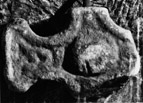
Object type: Cross-head (missing)
Measurements: Radius 21 cm (8.2 in); Boss diameter 10 cm (3.9 in); D. 12 cm (4.7 in)
Stone type: Unobtainable, but previously recorded as buff, medium-grained sandstone, probably local Millstone Grit (Sidebottom 1994, 226)
Plate numbers in printed volume: Ills. 192–5
Corpus volume reference: Vol 13 p. 178
(There may be more views or larger images available for this item. Click on the thumbnail image to view.)
Part of a relatively small cross-head. An iron rod extended from one of the truncated cross-arms, which probably resulted from an attempt to reconstruct a cross at some time in the past.
A (broad): This face is decorated on the surviving arm by a simple interlace pattern arranged as a trefoil motif with v-bend terminals which appears to be a closed-circuit pattern, although it is worn. At the centre is a protruding central boss with the hint of a thin moulding surrounding it. A further thin moulding surrounds the periphery of the cross-arms and trefoil pattern. The stubs of the other two cross-arms are visible, including that containing the iron rod, described above. Three arm pits are visible, the fourth broken away. There appears to have been decoration on the arm-pit stubs, although this is too worn to decipher.
B (narrow) and E (top): The other two cross-arms are broken away.
C (broad): Decorated with a central boss surrounded by a thin moulding, as on A. On the surviving arms is a hint of decoration but this is now too badly worn to decipher. However, it could well have been a simple interlace pattern arranged as a trefoil motif as on A. There is a thin moulding around the periphery of the cross-arms and the circle arm-pits between them. The stubs of the remaining two cross-arms are visible, including that containing the iron rod, and four arm pits are visible. There appears to have been decoration on the arm pits, although this is too worn to decipher.
D (narrow): Undecorated and worn
F (bottom): Broken away. There is no surviving evidence for the shaft.
This cross-head is one of only a few surviving from the region, and like those at Rowsley and One Ash in Derbyshire and that at Leek (5) in Staffordshire was type D11 (Cramp 1991, xiv), sharing with them a common form of decoration and central boss (see Ills. 237-42, 408-9, 579-81). The size of this cross-head (and its counterparts) suggests that it surmounted a relatively small cross-shaft.
