Select a site alphabetically from the choices shown in the box below. Alternatively, browse sculptural examples using the Forward/Back buttons.
Chapters for this volume, along with copies of original in-text images, are available here.


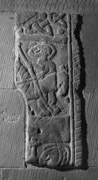
Object type: Part of cross-shaft
Measurements: H. 53 cm (20.9 in); W. max. 23 cm (9 in); D. unknown
Stone type: Pale yellowish brown (10YR 6/2), moderately sorted, clast-supported, medium-grained sandstone. The clasts vary from sub-angular to sub- rounded, and range from 0.3 to 5 mm across, but are dominantly 0.4 mm across. Scattered feldspars are present. Helsby Sandstone Formation, Sherwood Sandstone, Triassic (C.R.B.)
Plate numbers in printed volume: Ills. 535–8
Corpus volume reference: Vol 13 p. 283-285
(There may be more views or larger images available for this item. Click on the thumbnail image to view.)
The piece is bounded down the right-hand side by a wide angle moulding incised with diagonal lines to replicate cable moulding. This is inset with a thin vertical roll moulding. Below the upper break are the remains of an interlace pattern, with a wide flat ribbon forming two simple pattern E knots (Cramp 1991, fig. 23). This is separated from the decoration below by a flat horizontal moulding carved in low relief above which, on the right, is a small pellet.
Below the horizontal moulding are the remains of a rider. The head and forequarters of the horse are lost in the break in the stone on the left, but the neck is marked with a series of diagonal incisions, crossed horizontally by the reins, which extend to the rider’s left hand. Only the nearside hind leg is visible, kicking back towards the inner roll moulding on the right. The tail, shortened and tied in a knot, rises above the rump. The rider’s head, a rounded oval traversed by a line above the eyes, is awkwardly upturned, immediately below the horizontal moulding. The eyes, nose and mouth are all clearly delineated. A roll moulding, carved in comparatively deep relief and incised by a series of short lines set equidistantly at each corner and over the centre of the head, follows the line of the skull from the eyes to the back of the neck. The left shoulder and back of the figure follow a sharp outward curve, while the left and right arms extend from the chest area: the right hand to hold the reins, and the left to hold a long staff that extends diagonally across the panel, ending by the rider’s feet. A small part of the upper terminal survives by the break in the upper left-hand corner, which may represent the short horizontal arm of a cross. The rider’s body is marked at waist-height by a horizontal incision, seemingly indicating a belt. However, this line coincides with the outline of the horse’s back, and the short skirt could easily be confused with a saddle blanket, the lower edge following that of the horse’s belly. The rider’s legs, flexed at the knees, extend to the upper edge of a wide flat register separating the panel from that below.
Only the upturned head of a second figure survives below the plain register. The eyes are deeply drilled and the mouth is formed by a deeply incised line. A double outline runs around the top of the head, while a roll moulding incised with a series of radiating lines runs from the level of the ear round the head; a further, plain moulding runs around the top of this. A hand grasping a staff-cross with a hole drilled in the centre of the cross-head, survives to the left, the cross-head intruding into the plain register above.
The surviving interlace pattern is too fragmentary to provide much diagnostic information but it appears to be similar to the pattern E knots found elsewhere: at Ashbourne (1), Aston-on-Trent (1), for instance, and elsewhere in the Trent and Dove Valleys. The arrangement of pellets interspersed between knots further suggests the carving can be situated within the groups of sculptures in the region (at Bakewell, Hope and Norbury in Derbyshire; and Alstonefield, Checkley, Chesterton, Ilam and Leek in Staffordshire) that look to a decorative vocabulary established, or at least articulated most profusely in the ornamental scheme of the large-scale monuments in the market square at Sandbach (1–2), Cheshire, and their derivatives in the churchyard. This is further indicated by the cable moulding inset with a thin inner roll moulding running along the vertical edge, and the tendency to set the decoration in a series of panels running the length of the shaft (Bailey 2010, 99–120).
The figural style may also reflect similar sets of influence, in the slightly bent knees, awkwardly tilted, oval-shaped heads, and the double outline around the head, the function of which is often unclear, but in this instance the regular incisions form a cruciform shape and therefore strongly suggest that it forms a cruciform halo that identifies the figure with Christ. In this respect it is distinct from that set around the head of the cross-bearing figure below which, given its context, can also be understood to represent a halo. The motif at Sandbach and the fragments preserved on Bakewell 12, 15 and 16, as well as those apparently influenced by them (Bakewell 14; Hope 1), has here become a stylistic detail characteristic of the group that has been adapted to specifically identify Christ and the sacred nature of the figure below, while the upwardly tilted head is a motif also found on Bakewell 14 (Ill. 40).
Despite such points of coincidence, the Eccleshall figures also display features suggesting independent access to good quality models of early Christian type. In addition to the subtle manner in which the hindquarters of the horse emerge from the inner roll moulding and the way the cross of the lower figure obtrudes into the register separating the two figures, this dependence is seen in the rounded modelling of the horse’s hind-quarters and the clear diagonal lines marking its mane. Likewise, the segmented band surrounding the lower figure’s head seems to replicate early Christian portraits of figures with short curled hair, which in Insular contexts can be abstracted and stylised, as is the hair of David in the eighth-century Durham Cassiodorus (Durham, Cathedral Lib. MS B. II. 30, fols. 81v, 172v) and Book of Dimma (Dublin, Trinity College MS A. 4. 23, pp. 2, 30), the ninth-century Book of Cerne (Cambridge, Univ. Lib. MS Ll. I. 10, fol. 31v) and the later ninth-century Macdurnan Gospels (London, Lambeth Palace MS 1370, fols. 4v, 170v), or the eleventh-century Southampton Psalter, Cambridge, St John’s College MS C. 9, fol. 38v (Alexander 1978, 46, 69, 84–5, 86, 88, cat. 17, 48, 66, 70, 74, pls. 74–5, 222–3, 314, 326, 328, 351). In the Macdurnan Gospels the stylised curled hair is presented as two bands around the head, with the curve of the nimbus surrounding them–a manuscript version of the series of bands, plain and segmented, set round the heads of the sculptural figures at Eccleshall.
The rider forms one of a cluster of such figures preserved in the carved monuments of the region: on Bakewell 1, Derby St Alkmund 3, and Repton 1, in Derbyshire (Ills. 15, 155, 247); and across the Trent, south of Repton at Breedon-on-the-Hill, Leicestershire (Bailey 1990, 11–12; see Fig. 31b, p. 80). At both Breedon and Repton the riders are found in association with an image of Damnation: the devil at Breedon and the Hell Mouth at Repton (Hawkes 2011b). At Repton and Bakewell the riders clearly derive from the late antique tradition of the imperial adventus, or the closely related iconography of the victorious warrior which featured commonly on Roman tombstones across north-western Europe, including Britain, with that at Repton having been adapted to refer to the triumph of Christian Anglo-Saxon secular rule. The identification provided by the cruciform halo of the Eccleshall rider, along with the remains of what appear to be a cross at the top of the staff held in his hand, indicate that not only did the scheme likely derive ultimately from a similar iconographic source, but that it has been invoked here to present Christ milites, an adaptation of the adventus tradition that was being produced in Europe by the seventh century, as on a metalwork disc from Strasbourg that depicts a haloed rider with a cross staff piercing a serpent (Baum 1943, 18; Quast 2009, 330-42).[1] The supposition is further supported by the remnants of the figure in the lower panel who clearly bears a cross upraised and who, in the light of other such cross-bearing figures can perhaps be understood to have portrayed Christ resurrected or, at the very least, an ecclesiastical figure bearing a cross. Such an interpretation certainly seems more likely than viewing the rider purely as the memorial portrait of a local secular figure as is the case with many such figures in Yorkshire (Russell 2008).
Overall, although fragmentary, the carving indicates the presence, in the vicinity of Eccleshall, of a cross-shaft of impressive appearance. Admittedly, the figures are rendered in a rather confused manner, with the body of the rider seeming to stand, rather than sit on his horse–the punched lines of the belly and back of the horse transecting the rider and forming an apparent skirt; and the line of the reins crossing the staff of the cross, rather than passing behind it. Nevertheless, the rider’s hands grasp the staff coherently and hold the reins close to the body, while the remains of the hand of the lower figure are convincingly curled round the cross. The decoration is well carved, in low relief, with the background being finely dressed, and the whole being regularly disposed within the frames. In addition, it appears that the transom of the cross held by the lower figure still bears a central hole that may have been designed to hold an inset–a feature of a number of the sculptures in Mercia and the West Midlands dating the later eighth and ninth centuries: at Peterborough (Bailey 1990, 8–11, fig. 4) in the east, and Sandbach in the west (Hawkes 2002a, 145–7). Thus, the fragment sits within a cluster of sculptures in the region that echo motifs and iconographic schemes associated with impressive monuments of earlier ninth-century date, but which were adapted to suit the needs of the individual monuments.
