Select a site alphabetically from the choices shown in the box below. Alternatively, browse sculptural examples using the Forward/Back buttons.
Chapters for this volume, along with copies of original in-text images, are available here.


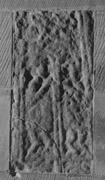
Object type: Part of cross-shaft
Measurements: H. 49 cm (19.25 in); W. max. 25 cm (9.9 in); D. unknown
Stone type: As Eccleshall 1
Plate numbers in printed volume: Ills. 539–40
Corpus volume reference: Vol 13 p. 285-286
(There may be more views or larger images available for this item. Click on the thumbnail image to view.)
The stone was bounded by a wide angle moulding inset with a thinner roll moulding; the remains are visible along the lower left-hand edge and the upper right. Contained within them are the vestiges of two figures standing in profile facing a central vertical moulding with an incision running down its length. That on the left is the clearer of the two: the outline of the head and profile are visible, with the right arm, bent sharply at the elbow, extending up towards the central divide. The body appears rather bulbous, and if clothed, the garment is very short: the legs, naked from the upper thighs, are clearly visible, the knees flexed, with one foot at least turned to the right. The other figure is less clear, but the legs, similarly disposed, are visible, and the left arm can be discerned, bent across the body and extended towards the central divide. Again, the body is rather bulbous, and if clothed, wears a very short garment. Alternatively, and more likely, the bulbous but worn outline of the bodies was formed by an arm crossing the body towards the legs. The area beneath the feet appears to form two slight mounds on either side of the central divide that extends to the break in the lower edge of the stone. Above the figures’ heads is an area that was decorated with either a plant motif or an elaborate, tightly knit interlace pattern. The central divide extends into this area, bifurcating over the head of the figure on the left, while the remains of a short strand extend down from the patterned area towards the head of the figure on the right.
Although so worn, the carving was coherently laid out, framed by a wide angle and thin inner roll moulding, with the central vertical element being clearly formed. Furthermore, consisting as it does of two figures standing on the ground from which the tree-like element extends and towards which they turn, strongly suggests that the scheme can be identified as having depicted Adam and Eve on either side of the Tree of Knowledge. Apart from the distinctive components of the carving and their layout, the interpretation is supported by the apparent nakedness of figures, the full length of their legs being visible, the way they reach up to, but do not grasp the central divide, and the way the interlacing (foliate) pattern extends down over their heads.
Stylisation of a centrally placed tree is found elsewhere in Anglo-Saxon sculpture in an image of the Miracle of the Loaves and Fishes on the ninth-century shaft at Hornby (1), Lancashire (Bailey 2010, 210–13, ill. 552), where the foliage of the tree is rendered as stylised branches and leaves. However, the complex pattern at Eccleshall bears more resemblance to those depicted in Irish versions of the scene. At Drumcliff, in Co. Sligo (Harbison 1992, 70–3, cat. 79/80, fig. 218) the tree has a bifurcated trunk extending from an interlace pattern forming the ‘ground’ on which Adam and Eve stand, while the foliage above is similarly composed of a complex interlacing pattern (Ill. 661). The same detail occurs at Durrow, Co. Offaly (Harbison 1992, 79–83, cat. 89, fig. 250) where the foliated interlace forms two strands that extend down towards the heads of Adam and Eve, as seems to have been the case at Eccleshall (Alexander 2018).
Furthermore, the Irish schemes often exclude the serpent and depict Adam and Eve, whether frontally posed or standing in profile, naked with their knees flexed; in many instances they also extend one hand across their bodies to hide their genitals, and the other upraised towards the tree, but in such a way as to hold the apple to their mouths (see Harbison 1992 for summaries). This arrangement may well explain the bulbous shape of the bodies at Eccleshall, while the way the figures here do not grasp the tree but have their hands raised towards their faces, probably indicates that they were originally depicted holding the apple to their mouths. More generally, the pose of the figures, with one hand raised and the other crossing the body, is one featured in Christian art from a very early date, surviving on sarcophagi and the Vienna Genesis (Österreichische Nationalbibliothek) from the fourth century (Harbison 1992, figs. 653, 656), and being reproduced in the ninth century in manuscripts looking back to early Christian prototypes, such as the Bible of San Paolo fuori le mura in Rome (Harbison 1992, fig. 659).
Although depictions of the Fall are reproduced with considerable regularity on the early Christian sculptures of Ireland, they are extremely unusual in Anglo-Saxon sculpture in pre-Scandinavian art (see Bailey 1977, 63; id. 1990, 11; Alexander 2018). Nevertheless, the scene is preserved on a ninth-century shaft which does not seem to have been produced under Scandinavian influence, at Newent (1) in Gloucestershire (Heighway 1987, 133, pl. on 132; Bryant 2012, 232–6, ills. 392–400; Alexander forthcoming). As at Eccleshall, the scheme was inspired by an early Christian model, albeit one depicting a different iconographic type.
At Eccleshall, while the flexed legs and coherent poses of the figures look towards a model of early Christian type (like those lying behind the figures flanking the Crucifixion scenes at Bakewell and Bradbourne), the stylisation of the tree suggests that, as with the Irish carvings, the model was adapted locally. Access to the model and the coherent rendition of the figures and the overall arrangement of the scene further suggest ecclesiastical patronage of some status lies behind the production of the carving.
