Select a site alphabetically from the choices shown in the box below. Alternatively, browse sculptural examples using the Forward/Back buttons.
Chapters for this volume, along with copies of original in-text images, are available here.


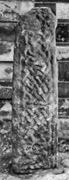
Object type: Part of shaft
Measurements: H. 138 cm (54.25 in); W. 40 > 31 cm (15.75 > 12 in); D. 22 > 13 cm (9 > 5 in)
Stone type: Moderately sorted, clast-supported, greyish orange pink (5YR 7/2), medium-grained sandstone showing ripple cross bedding. The clasts, varying from sub-angular to sub-rounded, are dominantly clear quartz in the range 0.3–0.5 mm, with a few coarser grains up to 1.0 mm. There are a few pinkish feldspar clasts. Shale Grit–, Hebden Formation, Millstone Grit Group, Carboniferous (R.T. & C.R.B.)
Plate numbers in printed volume: Ills. 196–9
Corpus volume reference: Vol 13 p. 176-177
(There may be more views or larger images available for this item. Click on the thumbnail image to view.)
Part of a shaft with the remains of the lower part of a cross-head. It is standing in a base stone, which is unlikely to be original. It is decorated on all four faces as follows.
A (broad): At the bottom of the shaft this face is decorated by a complete or encircled interlace pattern comprising six strands. However, the decoration is badly eroded and fine detail is missing. This appears to be joined by its outer strands to a similar pattern register above it. From this pattern, the outer strands extend upwards to a further pattern of interlace just below the top of the shaft, although this is so badly damaged that the detail of the interlace is missing, but it appears to be a truncated version of the patterns below. The three registers of patterning are contained within a moulded panel which is, again, badly eroded. The panel lies inside edge mouldings which may have been of the rolled variety but badly damaged. Above the upper horizontal moulding of the panel is a further horizontal moulding which appears to extend from the edge mouldings. The latter appears to be slightly curved and was almost certainly the base of a cross-head where the stone widens slightly on the right-hand side, over D, and then reduces towards an armpit, now largely missing. On the left-hand side the stone is damaged but the bottom of an armpit can be detected. The small part that remains of the cross-head is badly damaged and the decoration is missing.
B (narrow): Decorated by what appears to be a simple half-pattern interlace, but this face is so badly eroded that detail is lacking. It appears to have comprised a three-strand interlace, similar to that on D.
C (broad): This face is decorated with three registers of six-strand encircled interlace, similar to that on A, although detail is missing through damage and erosion. There is a further register of interlace pattern towards the top of the shaft which has all but eroded away and detail is lost. The top of the shaft on this face has been broken or eroded away.
D (narrow): This face is decorated by a half-pattern interlace which appears to comprise three strands, although erosion makes this uncertain. It seems to terminate in a trefoil terminal at the top, just below the shoulder of the broken cross-head; the bottom of the interlace is eroded away.
This is a simply-designed cross-shaft apparently utilising interlace patterns only, although the bottom of the shaft is either missing or buried in the base stone. The use of interlace patterns such as these is not particularly diagnostic in terms of regionality although three-stranded interlaces do tend to predominate in the relatively marginal areas of this region. There is a lack of symmetry to the patterning, suggesting that the craftsperson was not particularly experienced in masonry, or that symmetry was not important to the patron, or even that the lack of symmetry was intended to give an 'organic' feel to the decoration. It is one of several examples of crosses which appear to be in an ecclesiastical context but, historically, this is not so. There are no known pre-Conquest churches in the vicinity of Eccles Pike and it is, therefore, unlikely that it was originally erected in a churchyard.
