Select a site alphabetically from the choices shown in the box below. Alternatively, browse sculptural examples using the Forward/Back buttons.
Chapters for this volume, along with copies of original in-text images, are available here.


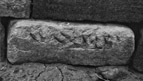
Object type: Possible fragment of cross-shaft
Measurements: H. (estimated) 14 cm (5.5 in); W. (estimated) 35 cm (14 in); D. unknown
Stone type: Medium-grained buff sandstone; probably local Millstone Grit
Plate numbers in printed volume: Ills. 190–1
Corpus volume reference: Vol 13 p. 176
(There may be more views or larger images available for this item. Click on the thumbnail image to view.)
The decoration is visible on one face only, being built into a wall. It is contained within a wide moulding on the bottom edge with the top edge apparently broken away. The decoration consists of what appears to be a two- or three-strand simple interlace but it is too worn to be certain; it seems to end in a terminal at the right-hand end; the left-hand end of the decoration is broken away.
The decoration on this shaft fragment appears to be typical of many shafts in the region, most of which are Anglo-Scandinavian. Another shaft fragment (Derwent 1) was found less than 100 metres away and it is possible that both pieces were once part of the same monument. The stone was found in proximity to the church in Derwent village which had no particular antiquity, but an older chapel existed a few metres away (Cox 1877a, 161). The original date of the chapel is unknown but it may have pre-dated the thirteenth century (Sidebottom 1993, 9-18).
