Select a site alphabetically from the choices shown in the box below. Alternatively, browse sculptural examples using the Forward/Back buttons.
Chapters for this volume, along with copies of original in-text images, are available here.


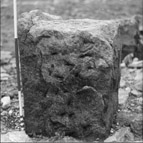
Object type: Part of a cross-shaft
Measurements: H. 59 cm (23.2 in) when excavated, but estimated before damage in 1991 at 81 cm (31.9 in); W. 33 cm (13 in); D. 22 cm (8.7 in)
Stone type: Recorded as fine-grained buff sandstone, probably Millstone Grit.
Plate numbers in printed volume: Ill. 189
Corpus volume reference: Vol 13 p. 175-176
(There may be more views or larger images available for this item. Click on the thumbnail image to view.)
The decoration on the un-dressed face appeared to comprise a simple pattern of a two-stranded interlace. At the end of each diagonal of the interlace was a closed-circuit ring.
The location of the stone was within a small building known as Mill Cottage which was abandoned and inundated by the reservoir in the 1940s. The cottage was adjacent to the site of a chapel in Derwent village which was extant in 1688, replaced by a smaller building in 1757 and demolished in 1867 (Cox 1877a, 161). The original date of the chapel is unknown but it may have pre-dated the thirteenth century (Sidebottom 1993, 9-18). Cox noted that older material was reused in the chapel buildings and Hallam (1989, 21) notes that some of the chapel masonry was eventually used in the fabric of Mill Cottage. Derwent was located in the Upper Derwent Valley, a wider part of the valley at the confluence of the River Derwent and Mill Brook, and the probable site of an early settlement in the district which, given the presence of two pieces of cross-shaft and the possible early date of the chapel, might have included an ecclesiastical focus of some form.
