Select a site alphabetically from the choices shown in the box below. Alternatively, browse sculptural examples using the Forward/Back buttons.
Chapters for this volume, along with copies of original in-text images, are available here.


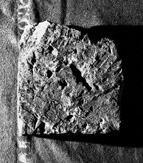
Object type: Cross-shaft fragment
Measurements: L. 34.5 cm (13.5 in); W. 29 < 32 cm (11.5 < 12.5 in); D. 17 cm (6.7 in)
Stone type: Limestone, yellow-brown, medium to coarse grained, ooidal and bioclastic. Middle Jurassic, Bajocian, Upper Lincolnshire Limestone Formation, Ancaster Stone
Plate numbers in printed volume: Ills. 9-13
Corpus volume reference: Vol 12 p. 101-2
(There may be more views or larger images available for this item. Click on the thumbnail image to view.)
This is a small fragment from a standing shaft decorated on at least two sides with interlace in low relief. The shaft decoration was originally contained within cable-moulded angle-rolls for which evidence survives between faces A and B, and D and A.
A (broad): This face was originally decorated with a regular grid of interlace with five, or perhaps six, strands, but it has been trimmed right back during reuse, especially on the side adjoining face B. The only surviving evidence for the decoration are traces of the strands against the angle roll between faces A and D and the holes for five interstices in the centre of the face and towards the angle with face D.
B (narrow): Decoration on this face survives in the central part of the stone. The surface has been trimmed back below and broken away above. The decoration consists of a run of plait-work with four strands. The surviving panel represents the terminal of the run, suggesting that this stone came from a location within the shaft near the ground. The run of plait-work terminates with a free ring and two loose ends. Not enough survives for the character of the next interlace unit upwards in the shaft to be comprehensible. The interlace strands are decorated with a medial line.
C (broad), D (narrow) and F (bottom): All re-cut
E (top): Crudely broken
This surviving fragment comes from a shaft which was originally only about 30 cm by 20 cm in section at the point at which the interlace runs on the side panels terminated. This observation permits two deductions. First, presuming that it was a monolith, the shaft represented was quite a small monument, probably standing no more than 1.5 m high. Secondly, the reconstructed dimensions of the shaft represent a monument with a section much more nearly square than the sections of monuments from the South Kesteven group of shafts (Everson and Stocker 1999, 29–33, table 2). Such dimensions are typical of the group of seventeen potential shafts from the Ancaster group of quarries found in Lincolnshire (ibid., 33–5, table 3; see this volume, p. 50-1). As is typical of the Lincolnshire members of this shaft group, the interlace patterns and style are very similar in character to interlace found on the mid-Kesteven covers group, which we presume therefore were contemporary products of the same quarries. This is, however, one of only three examples with cable-moulded angle rolls, the others being at Rolleston and Harmston. The mid-Kesteven covers have a date range determined typologically and it is thought that they were in production from the later tenth to the early eleventh centuries (ibid., 36–46, table 4; Chapter V above, p. 61). This is the likely date range for the Ancaster shafts, like Colston Bassett 1, also. The example from Colston Bassett is about 12.5 miles (20 km) from the likely quarry sources and is the most south-westerly of the Ancaster shafts (Fig. 6, p. 49).
