Select a site alphabetically from the choices shown in the box below. Alternatively, browse sculptural examples using the Forward/Back buttons.
Chapters for this volume, along with copies of original in-text images, are available here.


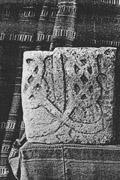
Object type: Part of grave-cover
Measurements:
No direct measurements of Coates 2 were taken when the stone was available for examination, except for its thickness, at 5.5 in. However, a scale is given by the calculated size of Coates 1 (q.v.), which is robustly based on the very standard form and decorative layout of the group of grave-covers to which it belongs (see below). A calculated estimate of the dimensions of Coates 2 on that basis is as follows:
L. 33.8 cm (13.3 in); W. 32.5 cm (12.8 in); D. 14 cm (5.5 in)
Stone type: [Lincolnshire Limestone, presumed to be of Lincoln origin]
Plate numbers in printed volume: Ill. 7; Figs. 10, 15
Corpus volume reference: Vol 12 p. 99-101
(There may be more views or larger images available for this item. Click on the thumbnail image to view.)
As Coates 1, with which this stone was found. On the evidence of its more regular shape in reuse, Coates 2 was probably the stone described as having been deployed as a coping stone for a wall.
Efforts — including local and family enquiries, consultation of Retford Museum, and a search of the grounds and surviving outbuildings at Morton Hall — undertaken in 2006 for the Corpus project, drew a blank in relocating these two stones (see Coates 1 for details).
A fragment from the end of a flat grave-cover of 'Lindsey type', decorated in low relief and only on its upper surface. The suggestion of Mr W. Stevenson, reported by Hill (1916a, 199; this is the older Mr Stevenson of Alfreton, see Chapter 1), that both stones from Coates derive from splitting a large cross-shaft along bedding lines (as was clearly engineered to create the two twelfth-century fragments at Minting, Lincolnshire.; Everson and Stocker 1999, 327–8) is clearly erroneous, but perhaps underscores their common stone type.
A (top): Two surviving original edges are defined by a single cable moulding, and the central panel is occupied by parts of two surviving interconnecting lines of simple pattern F interlace (Cramp 1991, xli, fig. 23), which produce a repetitive figure-of-eight pattern of which only one row can be seen. The complete figure-of-eight unit measures approximately 19 by 13 cm (7.4 x 5 in), which is very similar to Coates 1 and to other examples of the cover type. At the end of the field, the loose ends of the interlace strands are butted into the border angle via box points. Additionally, there is a broad cabled band or fillet running lengthwise between the lines of interlace, and this appears to taper towards either end as it approaches the criss-crossing of strands linking across from row to row — an impression in fact created because these crossings over-ride the cabled band. Though worn, all this decoration stands sharply as a squared U-section against the flat cut-away background in a manner typical of the cover type.
B (long): Undecorated, and evidently of square section
D (long) and C (end): Broken
E (end): Undecorated, and evidently of square section since the stone stands flat on this narrow edge in the published photograph (Mason 1904; see Ill. 7).
F (bottom): Roughly dressed originally and evidently undamaged in reuse (Mason 1904, 65).
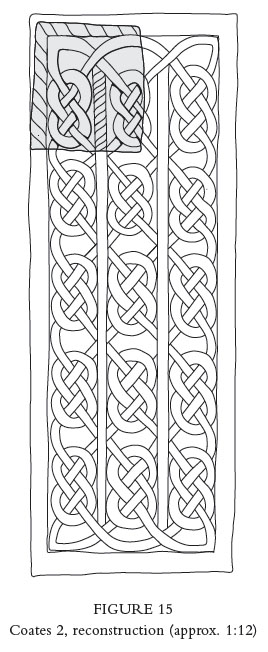
Even setting aside Stevenson's proposition that Coates 1 and 2 originate in a shaft split lengthwise, opinion has been divided about whether they derive from a single cover or from two separate monuments. Hill thought one (1916a, 199) but had probably not seen the stones; Bishop Browne was in favour of two, and provided a sketch of his understanding of the probable decorative layout of Coates 2 in his letter of advice to Mr Mason in 1895 (Nottinghamshire Archives, Acc 6426 box 1 of 5 (uncalendared)). This envisaged the pattern as decorating a slightly tapered cover and being based around a plain cross, with runs of interlace filling the long fields below the cross-arm and the smaller spaces above, in the manner perhaps of Ancaster covers such as Ewerby 1, Lincolnshire, and many covers of the Fenland and related type (Everson and Stocker 1999, 46–50, 165–6). Such south Lincolnshire products do not typically exhibit the regular cabled borders that are the hallmark of contemporary Lindsey products, however; and, more problematically, the cabled fillet — described by Hill as 'unusual spindle-shaped rods' presumably continuing the length of the stone (1916a, 199) — would not create a continuous reserved area that would read as a cross motif.
The intermediate fillet nevertheless differentiates Coates 2 from Coates 1 and is problematic to reconcile on a single monument. So too does the cable border, which at 3.5 cm (1.4 in) wide is narrower and with a smaller gauge of cabling than the 4.5 cm (1.8 in) width of Coates 1. A better understanding, available because of the body of material collected for the Lincolnshire Corpus volume, is that Coates 2 is part of a cover of Lindsey type (c) and comparable with variant examples such as Broughton 1 and Cumberworth 1 (Everson and Stocker 1999, 51–7, 116–17, 152–3, fig. 14; see this volume, pp. 61–6, and Fig. 10). Both those examples exhibit a median longitudinal ridge: Broughton with a single line of large figure-of-eight unit to either side, Cumberworth with a double line of smaller units, which however do not interconnect across the ridge. The latter consideration plus the standard size of the interlace units of Coates 2 probably suggest that that it had just the two lines, like Broughton. That would make a calculated original width of this cover 39–41 cm (15.4–16.5 in) at the foot end of what looks like a slightly tapering cover, which might chime with the rather narrow form of Broughton 1 as well. That example, also, has comparably narrow cabled borders. Alternatively, if the decoration had extended to three lines of interlace and a further longitudinal fillet (as reconstructed in Fig. 15) the cover's width would have been more like 60 cm (24 in), which is very much at the upper end of the stone size available from the Lincoln quarries for the most stylish of this group of monuments.
The problematic aspect of the location of discovery of these two stones from Coates — in a late and secular context of reuse, probably not for the first time, and outside the boundaries of historic Lindsey — has been discussed in the entry for Coates 1 above. The same arguments apply for Coates 2 since it is a reasonable assumption that their history was intimately linked, even if their origin was as two original monuments. As two original monuments rather than one, there is no reason why they should not have originated in a context of rural lordship, marking the founders' graves at rural churches and churchyards (such as Gate Burton was — p. 98 above), as has been the suggested significance of late pre-Conquest covers where they occur in ones and twos across the Danelaw (Everson and Stocker 1999, 71–2, 76–9; Everson and Stocker 2001). But two separate monuments surviving such vicissitudes of movement and reuse as these had, rather than just one, somewhat increases the possibility that they derive from a site likely to have had larger numbers of stone funerary monuments and of greater diversity of form than was typical for a rural settlement. It is a reasonable assumption that the booming Anglo-Scandinavian trading emporium at Torksey in Lincolnshire had a pre-Conquest church and church yard of precisely that profile, standing behind the riverfront hard and near the early marketing area. As discussed for Coates 1 (pp. 98–9), if it was not St Peter's — which survives and is one of the candidate sources for the load of stone reused at Coates — it may well have been St Mary's or All Saints. It is also tempting, in suggesting Torksey as the source of the Coates material, to align its merchant community with that on the Brayford at Lincoln itself, as well as those at Thetford and at Norwich, in that some of their number in each of these places chose to mark their burials with the very distinctive monuments that clearly signaled their affinity with the city of Lincoln (Stocker 2000; Everson and Stocker 2015).
