Select a site alphabetically from the choices shown in the box below. Alternatively, browse sculptural examples using the Forward/Back buttons.
Chapters for this volume, along with copies of original in-text images, are available here.


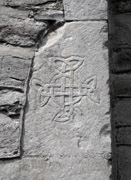
Object type: Architectural feature: quoin stone with consecration crosses? [1]
Measurements: L. 57 cm (22.5 in); W. 34 cm (13.5 in); D. > 23 cm (> 9 in)
Stone type: Limestone, yellow-brown, medium to coarse grained, ooidal and bioclastic. Middle Jurassic, Bajocian, Upper Lincolnshire Limestone Formation, Ancaster Stone. Identical to Costock 2 and face-bedded
Plate numbers in printed volume: Ills. 14-7
Corpus volume reference: Vol 12 p. 102-5
(There may be more views or larger images available for this item. Click on the thumbnail image to view.)
Both Costock 1 and 2 were photographed by the Rev. C. R. Manning, F.S.A., of Diss in the 1890s. A derived drawing rather than the photograph itself was published in the Illustrated Church News for 17 December 1892 ((—) 1892a) and a different derived drawing in The Antiquary ((—) 1892b; see Ill. 14 below).
In drawing attention to this monument, C. S. Millard noted that 'Bloxham' (recte Bloxam) saw the stones (both Costock 1 and 2) 'before he wrote his book, and again in 1868' (Millard 1902, 37). Bloxam's great, much-republished work was of course The Principles of Gothic [Ecclesiastical] Architecture, first published in 1829 and by the later 1840s already in its eighth or ninth edition. Millard's implicit presumption is clearly that Bloxam saw the stones in the quoin where they latterly sat, early in the nineteenth century and before the several programmes of rebuilding at St Giles.
He thought they might form part of a 'sepulchral monument'. G. G. Scott, too, clearly observed them, also by implication in their position in the quoin; and his recorded opinion is that they 'might have formed part of a churchyard cross' (Millard 1902, 37). These observations appear to fix the location of this stone, with its inferior companion, in the south-east quoin before the mid nineteenth-century restorations. The previous major work on St Giles is alleged to have been in the later seventeenth century (ibid.). The fabric of the south wall of the nave is undoubtedly different from that of the fourteenth-century south wall of the chancel, and it may be that, in whole or part, it is essentially an early survival and relates to a reported, though problematic, 'Norman' chancel arch, which may have survived to the seventeenth century (ibid., 32). The north wall of a putative early nave was destroyed in building the new north aisle in 1848 to the designs of Gordon Place of Nottingham, and the west wall was taken down and rebuilt in Scott's later campaign. The early capital, Costock 3, seems likely to be a relic of this nave (Appendix E, p. 221).
Some aspects of the stone itself chime with this thinking. Costock 1 appears to have been re-set in the location in which it is now found. The stone itself has suffered some mechanical damage consistent with reuse. Yet the cross on face B is now set partly behind the fourteenth-century south wall of the chancel, suggesting that it was here prior to that date. The upper parts of the nave quoin in which the stone is set are undoubtedly rebuilt, but whether that rebuilding included the re-setting of Costock 1 is a moot point. The nave itself was extensively rebuilt when the north aisle was added in 1848 and when the remainder of the church was restored under G. G. Scott in 1862 (Millard 1902; Pevsner and Williamson 1979, 106–7).
The stone was clearly known about before this date, however. If re-set, as the presence of an undoubtedly reused stone in the same quoin (Costock 2 — below) may suggest, the operation may simply have been a consolidation of the upper quoins. The argument that we set out below, indeed, may suggest that it was originally located in a very similar position to that in which it is now found, i.e. within a quoin (probably this south-east quoin) of the nave; and so, if re-set during the Victorian period, it may have been re-set close to its original position.
Costock 1 is a large square block, with carefully worked surfaces on two sides, which have been finely tooled using an undecorated blade and with a diagonal attack. Of the two invisible faces, D is clearly no longer finely worked, if it ever was, and nothing can be seen of face C.
A: The southern face is dominated by an impressive cross formed from interlace strands in low relief decorated with an incised medial line. The cross is of distinctive design based on 'Closed circuit pattern B', with a single free ring (Cramp 1991, fig. 24), but the cross 'arms' are extended well outside the ring and terminate, not in points, but in knots of 'simple pattern E' (ibid., fig. 23).
B: The eastern face is dominated by a cross of the same form as that on face A, but in this case the cross is bound within a deeply scribed circle. Beneath the major cross are the faint remains of two further interlace crosses. That to the lower right is so faint that it can hardly be read, although it is very likely that it took the same form as that to the lower left. This is a cross of 'eared' cross-pattée form, created out of a continuous interlace strand, which laces in and out of a free ring. In other words it is precisely 'Closed circuit pattern B', with only a single free ring (Cramp 1991, fig. 24). The precise pattern for these subsidiary crosses was illustrated by Allen and Anderson (1903, ii, 201, no. 495, 297, no. 771).
As noted above, the inclination of both Bloxam and Scott in the nineteenth century was clearly to view this stone and its companion (Costock 2) as re-cycled items from the dismemberment of an earlier monument of some sort. That has been the default stance, largely unexplored in detail, in all reporting of these items subsequently.
Costock 1 is an unusual stone, at least in the East Midlands, for at least two reasons: it is clearly of a singular function (discussed below), whilst the decorative motifs on both visible worked faces associate the stone with other, distant regions of the British Isles. Although the major interlace crosses on both visible faces of Costock 1 are apparently unique in the East Midlands, there are examples in Yorkshire on crossheads at Collingham (no. 5) and Kirkby Wharfe (nos. 1, 3 and 4), for example (Coatsworth 2008, 117–24, 185–9, ills. 164, 430, 432, 440, 442). The form is also frequently met with in both western Scotland, for example three examples at Iona (Allen and Anderson 1903, iii, 386, 390, figs. 401, 406) and Ireland, for example on the Cardonagh and Fahan Mura crosses, Co. Donegal (Harbison 1986, 49–51, 58–9, pls. 4.1, 4.9a) and, especially, in the Isle of Man. On Man, the form is deployed regularly enough for Kermode to have included two figures illustrating examples of it in his masterly book (1907, 41, 47, figs. 26 and 30), including examples at Ballaugh, Braddan (x2), Jurby and Michael (x2). The use of this cross-form at Costock, then, implies associations with the Hiberno-Norse of Yorkshire, Ireland and Man. The great majority of these crosses composed of interlace strands in this fashion are themselves constrained within 'ring-headed' forms, and some reminiscence of such an encircling ring might be intended by the scribed line containing the cross on the eastern face at Costock (Ills. 14, 17). Why a design with such unequivocal Hiberno-Norse pedigree comes to be carved into a block in the Trent valley is considered further in the introduction (see Chapters IV and VI, pp. 43, 68–9). It was a cross form, in fact, which lingered in the area, and a debased version of something similar occurs on the famous twelfth-century font from Lenton Priory, where the motif 's origin in the Carolingian period was canvassed by George Zarnecki, on the basis of manuscript depictions (Zarnecki 1998, 137–8, pl. XLIIIa).
But even if the design at Costock is of Hiberno-Norse inspiration, it probably does not date from the period of maximum Hiberno-Norse influence in the East Midlands, in the early tenth century. The subsidiary interlace crosses on the eastern face suggest a later date since, despite the fact that this motif occurs on monuments of the tenth century at, for example, Hawsker 1 (Yorkshire North Riding) (Lang 2001, 122–3) and of the eleventh century at Whitford no. 2 (Flintshire) and Meifod no. 1 (Montgomeryshire) (Edwards 2013, 366–71, 443–6), it also occurs on the fine shaft from Castle Bytham 2 (Lincolnshire), which probably dates from the twelfth century (Everson and Stocker 1999, 320–2, ill. 452). This combination of a cross type most frequently seen on eleventh-century sculptures on Man with a detail that occurs from the tenth through to the twelfth, probably suggests that the Costock sculpture is likely also to date from the eleventh century. The first documentary reference to the church comes in a grant made two generations after the Conquest; but it is the tenurial situation in the time of Edward the Confessor that may rather provide the context for an earlier church (Godfrey 1887, 68; Roffe 2012b, 210).
An initial presumption from the stone's appearance of having been re-set and perhaps re-cycled, might be — in line with previous antiquarian thought — that this was a section cut from a cross-shaft, which has suffered extensive damage to at least one of its faces. However, face D gives no sign of having been re-cut; it slopes and appears to have been roughly broken (Ill. 16). More conclusively, the complete lack of any vertical angle moulding strongly suggests that this was never part of an Anglo-Scandinavian shaft. If this were a section from a shaft, it would be the only example in the East Midlands without such an angle roll, and in fact shafts without angle mouldings are extremely rare nationally. Some grave-markers have no such mouldings, but this stone is of quite inappropriate proportions to have fulfilled this function. Another function therefore has to be suggested, namely that Costock 1 might represent a quoin stone of an early church with a pair of consecration crosses carved into the finished surfaces on two adjacent sides. Such an explanation seems to fit the known facts more comfortably than any other. In such an analysis, the chancel south wall would have been subsequently partly built up against the quoin in the fourteenth century, perhaps in association with a reconstructed chancel arch (Millard 1902), and either the stone was not disturbed during the 1862 re-construction of the nave, or (perhaps most likely) it was carefully removed and then re-set where it had been found.
An eleventh-century date for the Costock 1 carvings might also help our understanding of their function. In the earliest English account of consecration rituals (ad 732–66), no physical consecration cross is mentioned, but the bishop is enjoined to make crosses on the church walls with his thumb dipped in chrism, and the Leofric Missal of c. 900 mentions that the bishop should mark crosses on the corners and doorposts of the church with chrism (Muncey 1930, 68; and see now Gittos 2013, especially 220–1, 231, 239). There were developments in the complexity of the consecration ritual in the later tenth and eleventh century, however, and the Benedictional and Pontifical written at Winchester in the period 980–90, possibly for St Æthelwold himself (Rouen MS 369, the Benedictional of Archbishop Robert), ordered a more elaborate ceremony including the anointing of crosses on external walls as well as internal ones (Temple 1976, 53–4; Gittos 2013, 250, 256, and 280–1 for a brief summary and bibliography). At this date, however, it is still not clear that crosses would have been prepared for the bishop to anoint in advance. That particular elaboration is first mentioned in documents in the thirteenth century, although surviving examples suggest that painted and carved crosses were already being provided in the twelfth century. By the late Middle Ages 'the English manner' of consecration required twelve crosses inside and twelve outside (Muncey 1930, 69–72). Apart from these suggested examples at Costock, there do not appear to be any other clear examples of consecration crosses in England that adopt an Anglo-Scandinavian idiom. In Lincolnshire we were able to identify the simple incised cross at Cranwell as probably pre-Conquest through its architectural location, but this is an undecorated form of cross (Everson and Stocker 1999, 139, fig. 26). We considered the possibility that the crucifix at Ropsley (Lincolnshire) was a form of consecration cross, but discounted the idea partly because it is so high up, and partly because this sculpture is in very high relief and, we proposed, from a re-cut cross-shaft (ibid., 241–2, ills. 322–4). We thought at that time that there were no convincing examples of stone-sculpted eleventh-century consecration crosses surviving. Costock 1 suggests that we were probably wrong! And, by way of further analogy, we might cite the possible internal painted ones that have been identified, for example at St Martin's church in Wareham, Dorset (Park 1990, especially 230, 238 n.71–2, 241).
