Select a site alphabetically from the choices shown in the box below. Alternatively, browse sculptural examples using the Forward/Back buttons.
Chapters for this volume, along with copies of original in-text images, are available here.


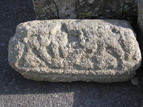
Object type: Part of grave-cover
Measurements: L. 80 cm (31.5 in); W. 42 > 38 cm (16.5 > 15 in); H. 29.5 > 25.5 cm (11.6 > 10 in)
Stone type: Coarse-grained Land's End Granite (A.V.B.)
Plate numbers in printed volume: Ills. 33-5; Fig. 20p
Corpus volume reference: Vol 11 p. 127-8
(There may be more views or larger images available for this item. Click on the thumbnail image to view.)
Small section from near the end of a recumbent type g coped grave-cover. In plan, this fragment tapers and it is uncertain whether the complete monument would have been boat-shaped (that is, at its widest near the centre, as Langdon thought: Langdon, Arthur, 1896, 417), or wedge-shaped, like the similar monument at St Tudy (Ills. 229–33). The angles have a simple roll-moulding and there are traces of decoration on the two sloping faces of the 'roof' only.
On one side of the 'roof' is a plant trail in which each volute is filled by a leaf of uncertain type. The plant trail springs from a root grounded on the lower horizontal edge of the 'roof'. The fact that at the narrower end of the stone the design appears to terminate with a back-turned leaf suggests that only a small piece has been lost from this end. On the other side of the 'roof' are traces of a diagonal fret of uncertain type. There appears to be no decoration on the sides.
This is the only example of a plant trail in Penwith. Plant trails are very common on crosses in mid and east Cornwall and this one is in fact most like the plant trail on the coped stone at St Tudy (Langdon, Arthur 1896, 414–16 and figs.; see Ill. 232). Frets do occur in Penwith, however, on St Erth 1 and Sancreed 1 (Ills. 68, 217). Unfortunately, the sculpture on the St Buryan 2 stone is too limited in extent and too worn to be able to make close comparison; the date suggested is therefore very tentative.
