Select a site alphabetically from the choices shown in the box below. Alternatively, browse sculptural examples using the Forward/Back buttons.
Chapters for this volume, along with copies of original in-text images, are available here.


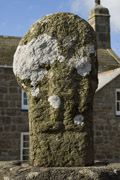
Object type: Cross-head and part of -shaft
Measurements: H. 80 cm (31.5 in); W. 42.5 cm (16.8 in) (head), 31.5 cm (12.4 in) (shaft); D. 20.5 cm (8.1 in)
Stone type: Coarse-grained Land's End Granite (A.V.B.)
Plate numbers in printed volume: Ills. 285-6
Corpus volume reference: Vol 11 p. 231-2
(There may be more views or larger images available for this item. Click on the thumbnail image to view.)
Cross-head and -shaft of rectangular section, set on top of a composite three-tier stone base. The two bottom tiers of the base are square in plan; the third is a single piece of granite of hexagonal plan into which the cross is socketed. The round-headed cross bears a simple relief-carved Crucifixion and cross on the head and has no other decoration.
A (broad): On the cross-head, with legs extending onto the shaft, is a simple doll-like figure of Christ carved in very shallow relief. Christ stands erect, wearing a knee-length tunic, with arms extended horizontally and over-large feet turned out. If any further detail was originally carved, it is not now visible.
B and D (narrow): No trace of any ornament
C (broad): On the head is a cross, type A1, formed by sinking triangles above the horizontal arms and incising triangles below them, leaving boss-like uncarved areas between the lower cross-arms.
Appendix D item (continuing tradition)
Thomas suggested that this cross and two others very like it in St Buryan parish (St Buryan 4 and 5, Ills. 287–8, 289–90) might pre-date and have helped inspire St Buryan 1 (p. 126, Ills. 29–32; Thomas, A. C. 1978, 78–9). However, for reasons more fully discussed under St Buryan 4 below, this theory is difficult to sustain. St Buryan 3 is a simple wayside cross with decoration derived from the churchyard cross, St Buryan 1, not the other way round. The Crucifixion is far simpler than that carved on the churchyard cross and the form of cross carved on the head can be compared with the Early Geometric designs used on cross-slab grave-covers of the early Norman period (Ryder 1991, 50–1).
The position of the cross just outside the church in an open area in the churchtown may indicate that, although originally intended for use as a wayside cross, the monument was re-used as a market cross in the late medieval period. A market at St Buryan is recorded in the fourteenth century (Preston-Jones and Rose 1986, 164; Preston-Jones and Langdon, Andrew 1997, 114).
